
How Much Does Property Management Cost in Orange County? 2026 Fee Guide
If you own a rental property in Orange County, one of the first questions you’ll probably ask before hiring a property manager is simple:
How much is this going to cost me?
The honest answer is that property management pricing depends on the company, the property type, the rent amount, and what services are included. In Orange County, many residential property management companies charge a monthly fee based on a percentage of rent, commonly around 7% to 10%, although some companies may charge lower or higher depending on the service model. Broader industry pricing sources also commonly place long-term rental management fees around 8% to 12% of monthly rent.
But the monthly percentage is only part of the real cost.
Leasing fees, renewal fees, setup charges, inspection fees, maintenance markups, vacancy fees, and cancellation terms can all affect what you actually pay. That is why Orange County landlords should compare the full annual cost, not just the advertised monthly rate.
This guide breaks down what rental property owners should expect, which fees are normal, which fees deserve closer review, and how to compare property management companies with more confidence. If you are still deciding whether the cost is worth it at all, it may also help to compare self-managing vs. hiring a property manager in OC before choosing a service model.
Table of Contents
Quick Answer: Property Management Fees in Orange County
Most Orange County property management companies charge a monthly management fee, usually based on a percentage of rent collected. A common range is around 7% to 10% for many full-service long-term residential rentals, but pricing can vary based on the property, rent amount, company, and service level. (Source)
Here is a simple breakdown:
| Fee Type | Common Range | What It Usually Covers |
|---|---|---|
| Monthly management fee | 7%–10% of rent is common | Rent collection, tenant communication, maintenance coordination, owner reporting |
| Leasing fee | 50%–100% of one month’s rent is common | Marketing, showings, screening, lease preparation, move-in coordination |
| Lease renewal fee | $200–$500 is common in some local pricing models | Renewal paperwork, rent review, tenant communication |
| Setup fee | $0–$500 | Account setup, document review, owner portal setup |
| Inspection fee | Varies by company | Move-in, move-out, annual, or mid-lease inspections |
| Maintenance markup | Varies by company | Added fee or markup on vendor invoices |
| Eviction coordination fee | Varies | Admin support, documentation, attorney coordination |
The key point is simple:
The lowest monthly percentage is not always the cheapest option.
A company that advertises a low monthly rate may still charge extra for leasing, renewals, inspections, vendor coordination, notices, or cancellations. A company with a higher visible fee may actually be more transparent if more services are included.
Monthly Management Fees
The monthly management fee is the recurring fee paid to the property management company for handling the day-to-day operation of your rental.
This usually covers the core work of managing the property, including rent collection, tenant communication, maintenance coordination, owner statements, lease enforcement support, basic accounting, coordination with tenants and vendors, and general rental oversight.
For example, if your rental property collects $3,500 per month and the management fee is 8%, your monthly management cost would be $280.
At 10%, the same property would cost $350 per month.
| Monthly Rent | 7% Fee | 8% Fee | 10% Fee |
|---|---|---|---|
| $2,500 | $175 | $200 | $250 |
| $3,500 | $245 | $280 | $350 |
| $4,500 | $315 | $360 | $450 |
| $5,500 | $385 | $440 | $550 |
For higher-rent properties in Irvine, Newport Beach,Huntington Beach, and Costa Mesa, percentage-based pricing can become expensive quickly.
That does not automatically mean percentage-based pricing is bad. It simply means owners should understand exactly what they are paying for.
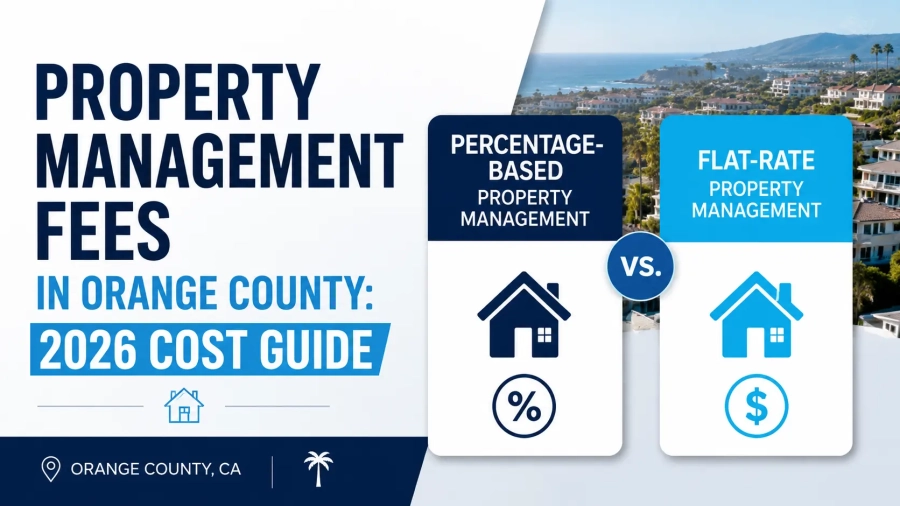
Percentage-Based vs. Flat-Rate Pricing
Most traditional property management companies charge a percentage of monthly rent. This model is common because it is easy to understand and scales with the rental income.
However, percentage-based pricing can become less attractive for higher-rent homes. A $5,000 rental does not always require twice as much monthly management work as a $2,500 rental, but a percentage-based fee may charge significantly more.
Flat-rate property management works differently. Instead of charging a percentage of rent, the company charges a fixed monthly amount.
Flat-rate pricing may be a better fit if your rental has above-average rent, you want predictable monthly costs, you dislike percentage-based fees, you want clearer billing, or you prefer a simpler pricing structure with fewer surprise charges.
DirectPads uses a flat-rate, technology-driven property management model designed for owners who want clear pricing, no hidden fees, no vendor markups, automated rent collection, real-time reporting, and less day-to-day stress. For owners comparing both models, a deeper guide on flat-rate vs. percentage-based property management can help clarify which structure may save more over time.
This is especially appealing for owners who are tired of traditional property management pricing that feels unclear or difficult to compare.
Example Cost Breakdown
Let’s say your Orange County rental property rents for $3,500 per month.
Here is what your annual monthly management fee could look like:
| Management Rate | Monthly Cost | Annual Cost |
|---|---|---|
| 7% | $245 | $2,940 |
| 8% | $280 | $3,360 |
| 10% | $350 | $4,200 |
| 12% | $420 | $5,040 |
Now add a leasing fee.
If the leasing fee is 50% of one month’s rent, that adds $1,750. If the leasing fee is equal to one full month’s rent, that adds $3,500.
That means your first-year cost may look like this:
| Scenario | Annual Management Fee | Leasing Fee | First-Year Total |
|---|---|---|---|
| 7% + 50% leasing fee | $2,940 | $1,750 | $4,690 |
| 8% + 50% leasing fee | $3,360 | $1,750 | $5,110 |
| 10% + full-month leasing fee | $4,200 | $3,500 | $7,700 |
| 12% + full-month leasing fee | $5,040 | $3,500 | $8,540 |
This is why landlords should never compare property managers based on the monthly percentage alone.
The better question is:
What will I pay during the first year, and what will I pay during a normal renewal year?
The first year is often more expensive because it may include leasing, onboarding, inspection, and tenant placement work. If the tenant renews, the second year may cost less.
Leasing and Tenant Placement Fees
A leasing fee, sometimes called a tenant placement fee, is charged when the property manager finds a new tenant for the rental.
This fee may cover rental pricing strategy, listing creation, online advertising, showing coordination, tenant screening, credit and background checks, income verification, rental history review, lease preparation, move-in coordination, and security deposit handling.
Leasing fees often range from 50% to 100% of one month’s rent, depending on the company and what services are included. (Source)
A leasing fee is not automatically a bad thing. In fact, placing the right tenant is one of the most important parts of property management. A poorly screened tenant can cost far more than the leasing fee through late rent, property damage, vacancy, legal issues, or early turnover.
Still, owners should ask:
- When is the leasing fee charged?
- Is it due only after a tenant is placed?
- What screening is included?
- Is lease preparation included?
- Are property photos or advertising included?
- Is there a tenant placement guarantee?
- What happens if the tenant breaks the lease early?
A major red flag is a large leasing fee charged before meaningful leasing work is completed.
Because leasing is closely tied to risk, landlords should also understand how to screen tenants legally in California before comparing tenant placement fees.
Lease Renewal Fees
A lease renewal fee is charged when an existing tenant signs a new lease.
This fee may cover reviewing market rent, recommending renewal terms, communicating with the tenant, updating lease documents, collecting signatures, updating owner records, and reducing vacancy risk.
Some local pricing sources show renewal fees around $200 to $500, though the exact fee depends on the company and scope of work. (Source)
A renewal fee can be worthwhile if the manager is doing more than sending paperwork. A good renewal process should evaluate whether the rent is still competitive, whether the tenant has performed well, and whether renewing is better than turning over the property.
The question to ask is simple:
What exactly do you do for the renewal fee?
If the answer is vague, that fee deserves a closer look.
Setup and Administrative Fees
Some property management companies charge a setup or onboarding fee. Others waive it.
A setup fee may cover owner portal setup, property file creation, lease review, tenant ledger setup, bank connection, payment setup, document collection, initial onboarding, or transition from another manager.
The fee itself is not always the problem. The problem is unclear billing.
Before signing, ask:
- Is the setup fee one-time or recurring?
- Is it charged per property or per unit?
- Is it refundable if onboarding is not completed?
- Are there separate technology or admin fees?
- What exactly is included?
DirectPads helps simplify this part of the process with $0 setup fees, month-to-month service, and no long-term contracts.
That kind of pricing clarity matters, especially for owners who are already frustrated with unclear property management charges.
Maintenance Coordination and Vendor Markups
Maintenance is one of the most important areas to review before choosing a property manager.
A monthly management fee may include basic maintenance coordination, but the actual repair cost is usually paid by the owner. Some companies also charge a markup on vendor invoices.
Maintenance coordination can include receiving tenant repair requests, troubleshooting simple issues, dispatching vendors, reviewing estimates, getting owner approval above a certain threshold, coordinating tenant access, tracking invoices, confirming completion, and updating owner records.
Some property managers charge no vendor markup. Others may add a percentage or coordination fee to maintenance invoices.
Here is the strong opinion: vendor markups should never be hidden.
If a management company adds a maintenance markup, coordination fee, referral fee, or vendor incentive, that should be clearly disclosed in writing.
Owners should ask:
- Do you mark up vendor invoices?
- Can I see the original vendor invoice?
- Do I approve repairs above a certain amount?
- Do you use licensed and insured vendors?
- Is there a maintenance reserve?
- Do you receive rebates or referral fees from vendors?
- How are emergency repairs handled?
DirectPads’ no-vendor-markup model is a major advantage for owners who want transparent maintenance costs and better visibility into repair decisions. For landlords who want more speed and less confusion, AI-powered maintenance for rental properties can also help reduce the stress of handling repairs manually.
Inspection Fees
Inspections help protect the property and document its condition.
Common inspection types include:
- Move-in inspection
- Move-out inspection
- Annual inspection
- Mid-lease inspection
- Exterior inspection
- Maintenance inspection
- Post-repair inspection
For Orange County rentals, inspections are especially important for single-family homes, condos, coastal properties, older rentals, and HOA-governed properties. A small leak, unauthorized pet, lease violation, or deferred repair can become expensive if it goes unnoticed.
A property manager should be able to explain how often inspections happen, whether they are included or billed separately, whether photos are provided, how findings are reported, and whether move-in and move-out documentation is included.
California landlords also need to follow proper rules before entering an occupied rental. The California Department of Real Estate provides a 2026 landlord-tenant guide covering landlord and tenant rights and responsibilities.
Legal and Eviction Coordination Fees
Eviction-related services are usually not included in the standard monthly management fee.
A property manager may help with documentation, tenant communication, notice coordination, attorney coordination, timeline tracking, move-out coordination, and owner updates. However, property managers are not a substitute for legal counsel. If an eviction, dispute, or legal claim occurs, owners should work with a qualified attorney.
California rental law is compliance-heavy. Many residential rentals may be subject to California’s Tenant Protection Act, which includes rent cap and just-cause eviction rules unless an exemption applies. The California Department of Justice explains that the Tenant Protection Act generally caps rent increases for many covered units at 5% plus the cost-of-living change or 10%, whichever is lower. (Source)
Owners should ask:
- What eviction-related services are included?
- What is billed separately?
- Are attorney fees separate?
- Who prepares notices?
- Who chooses the attorney?
- How are tenant communications documented?
Legal coordination fees are not always avoidable, but they should be clearly explained before a problem happens. If rent collection or nonpayment becomes an issue, owners may also want to review what to do when a tenant is not paying rent in Orange County and what to expect from the Orange County eviction timeline.
Hidden Fees to Watch For
Before signing a property management agreement, ask for a complete fee schedule.
Watch for:
- Vacancy fees
- Marketing fees
- Photography fees
- Lease preparation fees
- Notice posting fees
- Technology fees
- Annual statement fees
- Maintenance markups
- Emergency coordination fees
- HOA coordination fees
- Insurance claim coordination fees
- Court appearance fees
- Cancellation fees
- Early termination fees
- Reserve fund requirements
The biggest mistake landlords make is comparing one company’s 8% monthly fee to another company’s 10% monthly fee without comparing the full fee structure.
A “cheaper” manager can become more expensive if every normal task is billed separately.
A transparent company should be able to explain the full cost before you sign.
What Should Be Included in Full-Service Property Management?
A full-service property management company should do more than collect rent.
At minimum, full-service management should usually include leasing and marketing, tenant screening, rent collection, accounting, maintenance coordination, lease management, compliance awareness, inspections, and owner communication.
Leasing and marketing may include rent-price analysis, listing creation, marketing, showings, lead follow-up, and application processing. Tenant screening should review credit, income, rental history, employment, and other lawful criteria.
Rent collection and accounting should include online rent collection, late-payment tracking, owner statements, invoice records, and direct deposits. DirectPads also emphasizes automated rent collection, faster owner payouts, and real-time owner reporting.
Maintenance coordination should include repair request handling, vendor dispatch, estimate review, invoice tracking, and owner communication. Lease management should include renewals, notices, rent increases, documentation, and awareness of California landlord-tenant requirements. Managers should not replace attorneys, but they should have disciplined systems.
Owners should not have to chase basic updates. A strong company should provide clear communication, owner portal visibility, maintenance updates, and transparent reporting.
What Affects Property Management Pricing in Orange County?
Several factors can affect your final cost.
Property type
Single-family homes, condos, townhomes, duplexes, and small multifamily buildings may be priced differently. A condo may involve HOA coordination. A single-family home may require more exterior maintenance. Multifamily properties may qualify for per-unit or portfolio pricing.
Location
Pricing and service needs may vary across Irvine, Anaheim, Newport Beach, Huntington Beach, Costa Mesa, Santa Ana, Fullerton, Orange, and Laguna Beach.
Coastal homes may have higher rents and higher repair costs. Inland properties may have different tenant demand and leasing timelines.
Rent amount
The higher the rent, the more expensive percentage-based pricing becomes. This is one reason flat-rate pricing can make sense for higher-rent properties.
Property condition
Older homes or rentals with deferred maintenance often require more coordination. If the property has aging plumbing, old appliances, roof concerns, or frequent tenant complaints, management may require more work.
Service level
Basic rent collection should cost less than full-service management. If you want leasing, inspections, maintenance, reporting, compliance support, and owner communication, compare full-service packages.
Number of units
Owners with multiple rentals may qualify for bundled or portfolio pricing.
For owners managing a property from outside the area, pricing should also be weighed against the practical challenges of managing an Orange County rental while living out of state.
Savings Calculator: How Much Are You Overpaying Your Property Manager?
If you already have a property manager, the monthly percentage may not show the full cost.
Your real annual cost may include:
- Monthly management fees
- Leasing fees
- Renewal fees
- Inspection fees
- Maintenance markups
- Vacancy fees
- Admin charges
- Cancellation fees
How to Compare Orange County Property Management Companies
Do not compare companies based only on the monthly rate.
Compare these instead:
1. Complete fee schedule
Ask for every possible charge in writing. If the company only gives you the monthly percentage, ask for the full fee schedule.
2. What is included
Two companies may both charge 8%, but one may include more services while the other bills separately for normal tasks.
3. Contract terms
Review:
- Contract length
- Cancellation terms
- Leasing fee timing
- Maintenance approval limits
- Reserve requirements
- Owner payout schedule
- Reporting schedule
- Vendor policy
- Eviction coordination process
DirectPads offers month-to-month service, no long-term contracts, and cancel-anytime flexibility, which can be helpful for owners who do not want to feel locked in.
4. Maintenance transparency
Ask whether vendor invoices are marked up and whether you can see original bids and invoices.
5. Owner reporting
Ask for a sample owner statement or dashboard. If a company cannot show you how reporting works, be cautious.
6. Local experience
A property manager should understand Orange County rental expectations, HOA issues, rent differences, tenant demand, and local market behavior.
If you already have a manager but feel frustrated by unclear pricing, poor communication, or surprise charges, it may be time to understand how to switch property management companies without disrupting tenants, rent collection, or maintenance.
Red Flags in Property Management Pricing
Be careful if you see:
- Vague pricing
- No written fee schedule
- Very low advertised rates with many add-ons
- Leasing fees charged before performance
- Hidden maintenance markups
- No clear cancellation terms
- Long-term contract pressure
- No owner reporting sample
- Poor communication before signing
- No clear explanation of what is included
If a company is hard to understand before you sign, it probably will not feel clearer after you sign.
Good property management should make ownership simpler, not more confusing.
How to Lower Your Property Management Costs Without Choosing the Cheapest Company
The goal is not to hire the cheapest property manager. The goal is to lower your real cost while protecting your rental.
Well-maintained rentals usually lease faster, attract better tenants, and create fewer emergency repairs. Pricing rent correctly also matters because overpricing can increase vacancy while underpricing leaves money on the table. In a high-rent market like Orange County, pricing mistakes can be expensive.
Owners should also prioritize quality tenants over fast tenant placement. Strong screening protects cash flow and reduces future problems. If your rent is high, flat monthly pricing may cost less than percentage-based pricing, especially when the company also avoids hidden maintenance markups.
The best comparison is annual cost, not monthly percentage. Ask every company: “What would my estimated first-year cost be, including leasing, renewals, inspections, and maintenance markups?”
Technology can also reduce friction. Automated rent collection, AI-powered maintenance workflows, owner portals, transparent invoices, and faster payouts can reduce stress and improve visibility.
For owners comparing total value, it may also help to understand the hidden costs of self-managing a rental property in Orange County because doing everything yourself can have costs that do not show up as a monthly invoice.
The Bottom Line: What Should Orange County Landlords Expect to Pay?
Most Orange County landlords should expect property management costs to include a monthly management fee plus possible leasing, renewal, inspection, maintenance, and administrative fees.
A common monthly range for many full-service long-term rentals is around 7% to 10%, though pricing can vary by company, property type, rent amount, service level, and contract structure. Leasing fees are often one of the largest first-year costs and may range from 50% to 100% of one month’s rent. (Source)
But the best property manager is not always the cheapest.
The right company should provide:
- Transparent pricing
- A complete fee schedule
- Strong tenant screening
- Clear maintenance workflows
- No surprise markups
- Reliable rent collection
- Fast owner payouts
- Real-time reporting
- Local market knowledge
- Clear cancellation terms
- Less stress
If you want a more transparent alternative to traditional percentage-based pricing, DirectPads is built for Orange County and Southern California rental owners who want flat monthly pricing, no hidden fees, no vendor markups, no long-term contracts, automated rent collection, AI-powered maintenance workflows, and real-time owner visibility.
| DirectPads | Typical PM firm | |
|---|---|---|
| Monthly fee | $199–$299 flat | 8–12% of rent |
| Tenant placement | $0 or $1,500 flat | 50–100% of 1 month |
| Repair coordination | $0 or 5% over $1K | 10–20% markup |
| Lease renewal fee | $0 | $200–$500 |
| Setup fee | $0 | $200–$500 |
| Contract length | Month-to-month | 12–24 months |
| Vendor invoices | Full transparency | Marked up |
| Owner portal | Real-time access | Monthly PDF |
Want to know what property management would cost for your rental? Tell us about your property and request a
Free Rental Analysis. We’ll help you compare your current costs, understand your options, and see whether flat-rate, technology-driven management makes sense for your rental.
Frequently Asked Questions About Property Management Fees in Orange County
What is the average property management fee in Orange County?
Many Orange County property management companies charge around 7% to 10% of monthly rent for full-service long-term residential management, although pricing can vary based on the property, service level, and company.
How much is a leasing or tenant placement fee?
Leasing fees often range from 50% to 100% of one month’s rent, depending on what services are included and when the fee is charged.
Are property management fees tax deductible?
Rental property owners can generally deduct expenses related to renting property from rental income, but owners should confirm their specific tax situation with a CPA or tax professional. The IRS provides guidance on rental income, expenses, and recordkeeping.
Do property managers charge when the property is vacant?
Some companies charge vacancy fees, while others only charge when rent is collected. Always ask whether the monthly fee is based on collected rent or scheduled rent.
Are maintenance costs included in property management fees?
Usually, no. The management fee may cover coordination, but the owner typically pays the actual repair cost. Some companies may also charge a maintenance markup.
Is flat-rate property management better than percentage-based pricing?
It depends on the property. Flat-rate pricing can be better for higher-rent homes or owners who want predictable costs. Percentage-based pricing may still make sense when the included service level justifies the fee.
What hidden fees should landlords watch for?
Watch for setup fees, renewal fees, vacancy fees, inspection fees, maintenance markups, cancellation fees, technology fees, notice fees, and administrative charges.
How much does property management cost for a $3,500 rental?
At 8%, monthly management would cost $280 per month, or $3,360 per year before leasing or other fees. If the leasing fee is 50% of one month’s rent, that adds $1,750 in the first year.
What should be included in full-service property management?
Full-service management should usually include rent collection, tenant communication, maintenance coordination, owner reporting, leasing support, tenant screening, inspections, and general property oversight.
How do I compare property management companies in Orange County?
Compare the full fee schedule, included services, contract terms, maintenance markup policy, owner reporting, local experience, cancellation terms, and communication standards. Do not choose based only on the lowest monthly percentage.