
AI-Powered Property Management in Los Angeles, CA
DirectPads helps Los Angeles landlords manage rentals smarter with AI-powered tools for tenant screening, rent collection, maintenance coordination, and portfolio organization.

AI-Powered Property Management in Los Angeles, CA
DirectPads helps Los Angeles landlords manage rentals smarter with AI-powered tools for tenant screening, rent collection, maintenance coordination, and portfolio organization.

Overview
About Los Angeles, CA
Los Angeles, California is the largest city in Los Angeles County and one of the most influential urban real estate markets in the United States. The U.S. Census Bureau estimates the city’s population at 3,869,089 as of July 1, 2025, giving Los Angeles one of the deepest renter pools in California. The city also has more than 1.4 million households and an owner-occupied housing rate of only 36.0%, which reinforces the importance of rental housing across the local market.
The city’s appeal is driven by its scale, diverse neighborhoods, major employment centers, and lifestyle destinations such as Hollywood, Downtown Los Angeles, Venice, Koreatown, Silver Lake, Westwood, and coastal-adjacent communities. Tourism also remains a major part of the broader Los Angeles economy; Discover Los Angeles reported that L.A. County recovered to 46.4 million visitors in 2022, generating more than $22 billion in visitor spending. For landlords and investors, Los Angeles offers a wide range of rental property types—from older rent-stabilized multifamily buildings to luxury apartments, single-family rentals, ADUs, and mixed-use urban properties—making Property Management in Los Angeles, CA both opportunity-rich and compliance-heavy.
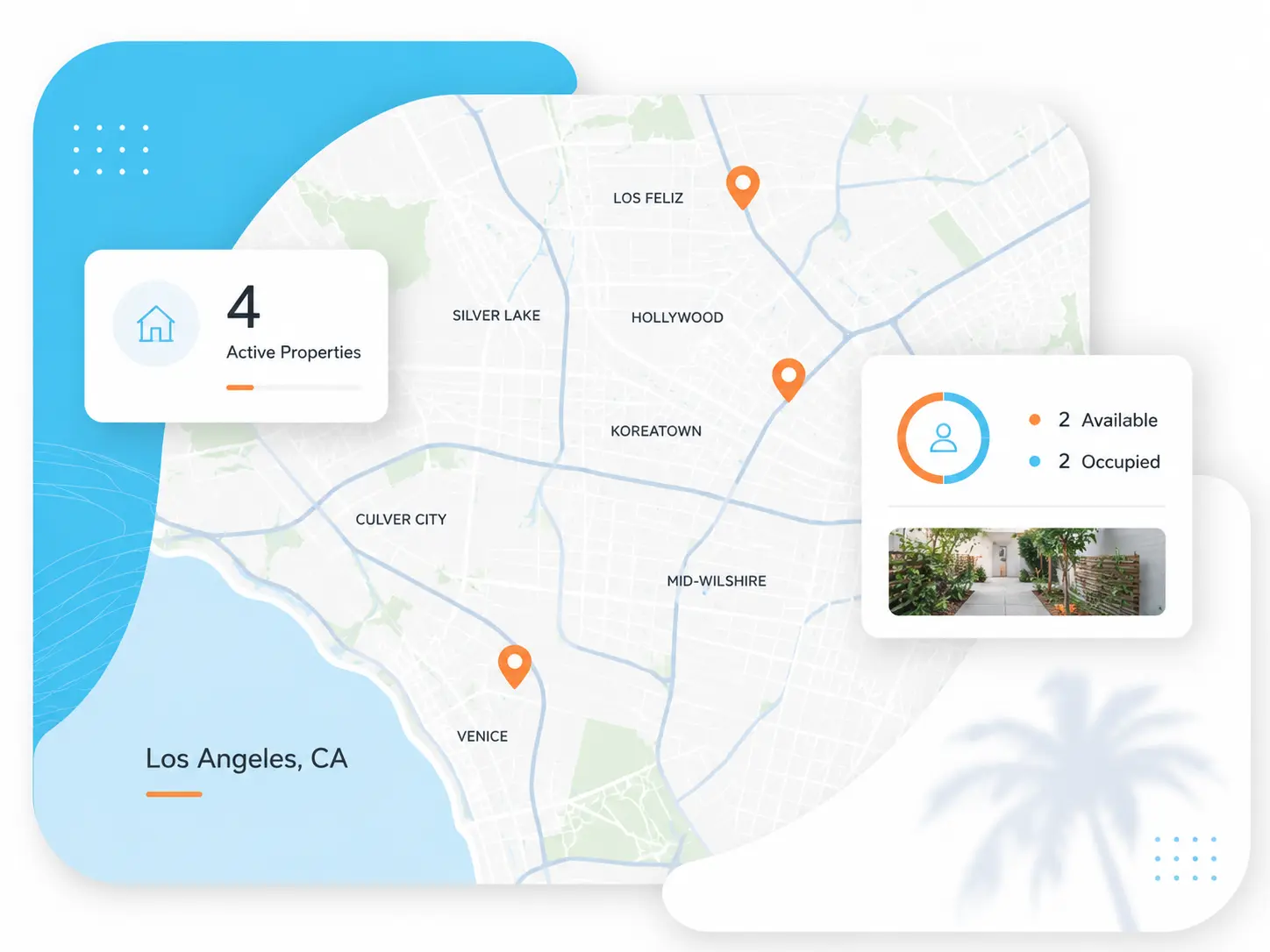
Los Angeles Rental Demand
Los Angeles remains a large but more competitive rental market in 2026, with city rental vacancy estimated around 4.6% and metro multifamily vacancy reported near 5.6% in Q1 2026. (Source) Investors are still drawn to the city’s high rent base, diverse housing stock, and long-term tenant demand, but Los Angeles, CA Property Management Services must account for strict local rent stabilization, just-cause eviction rules, tenant anti-harassment protections, and rental inspection requirements. (Source)
Opportunity
Why Landlords Succeed Here
Los Angeles landlords succeed by combining strong rental demand with smart, organized management. With the right pricing, tenant screening, rent collection, and maintenance systems, owners can reduce vacancy, protect cash flow, and grow rental income in one of California’s most competitive markets.
DirectPads helps make that easier with AI-powered tools built for LA landlords.
2026 Rent Snapshot
Average Monthly Rents in Los Angeles
Rental pricing in Los Angeles is based on RentCafe apartment market trend data, including average rent by unit type and year-over-year movement.
Apartment Average Rent
$2,749
↓ 0.19% Year over year
One Bedroom Average
$2,538
Monthly average
Two Bedroom Average
$3,361
Monthly average
Three Bedroom Average
$4,327
Monthly average
Rent by Unit Type
A quick visual comparison of monthly apartment rent levels.
↗Rental Trend Insight
Los Angeles apartment rents are currently showing a ↓ 0.19% year-over-year movement, with larger floor plans generally carrying the highest monthly averages.
Data shown: RentCafe average rent market trends. Source Figures reviewed as of the date shown.
2026 Rent Snapshot
Average Rent in Orange County
Orange County apartment pricing remains elevated, with recent market sources showing strong monthly rent levels and modest year-over-year growth.
Average Apartment Rent
$2,865
↑ 1.26% Year over year
Q1 Multifamily Average
$2,896
Per unit, per month
1-Bedroom Apartments
$2,543
Monthly average
2-Bedroom Units
$3,152
Monthly average
Rent by Unit Type
A quick visual comparison of monthly rent levels.
↗ Market Takeaway
Strong rent levels can support income potential, but pricing should still account for tenant affordability, neighborhood differences, and nearby new supply.
Data shown: RentCafe / Yardi Matrix, April 2026; CBRE Q1 2026. Figures are monthly rent averages.
Market Stats
Vacancy Rates in Los Angeles, CA
The most locally specific 2026 vacancy estimate found for the City of Los Angeles reports a rental vacancy rate of 4.6%, below the listed stable target of 7.4%, suggesting that the city still has constrained rental supply relative to demand. (Housing Forecast)
- For a broader market proxy, a Q1 2026 Los Angeles multifamily report placed the Los Angeles metro vacancy rate at 5.6%, up 80 basis points year over year, showing a softer but still active rental market compared with ultra-tight coastal Orange County cities. (Kidder Mathews)
Why This Matters: For landlords and property managers, these Los Angeles, CA Rent and Vacancy Rates point to a market where pricing must be competitive, but well-managed rentals can still benefit from strong renter depth.
Everything You Need
In One Place.
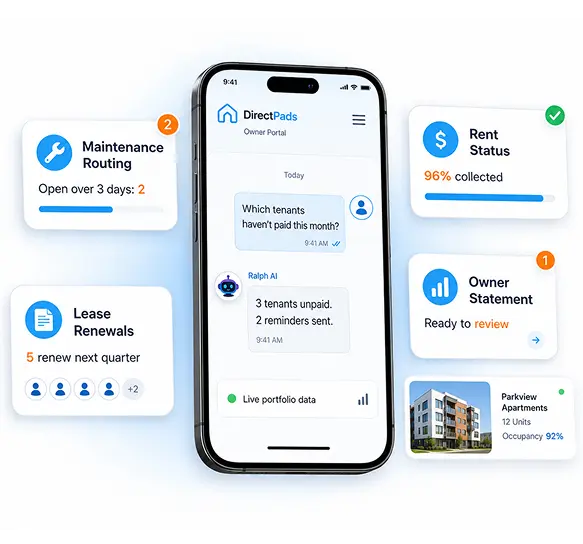
DirectPads brings tenant screening, rent collection, and maintenance coordination together in a single dashboard. No more switching between apps or chasing down information.
AI Maintenance Coordination
Tenants submit repair requests 24/7 with photos. Issues are routed, tracked, and documented from request to resolution.
Rent Collection & Fast Owner Payouts
Tenants pay online, reminders run automatically, and owner payouts are sent within 24–48 hours after collection.
Real-Time Owner Portal
See rent status, expenses, invoices, photos, maintenance updates, and monthly statements without waiting on email updates.
Tenant Communication
DirectPads helps manage tenant requests, payment reminders, maintenance updates, and everyday communication with a clear response process.
Vendor Bids With Zero Markup
We coordinate vendor bids and repair work without padding invoices. You see the real cost, not a marked-up version.
Monthly Statements & Reporting
Track income, expenses, maintenance costs, invoices, and owner statements in one clean, transparent reporting system.
Move-In / Move-Out Documentation
Photos, maintenance history, rent records, invoices, and unit-level documents are organized so important details do not disappear.
Ralph AI Portfolio Assistant
Ask plain-English questions about unpaid tenants, open repairs, lease renewals, reports, and property activity across your portfolio.
Modern management for owners who want fewer surprises.
Flat monthly pricing. Transparent repairs. Real-time visibility. A simpler way to manage rentals across Southern California.
Local Legal Considerations for Property Management in Los Angeles, CA
Los Angeles is a strong rental market, but it is also one of the most regulated places to own rental property in California. For landlords, investors, and property owners, good management is not just about collecting rent, it is about protecting the asset, staying compliant, and reducing avoidable risk. Below are key legal areas Los Angeles rental owners should keep on their radar.
Los Angeles Rent Stabilization Ordinance
Many Los Angeles rental properties are covered by the city’s Rent Stabilization Ordinance, commonly called RSO. In general, RSO applies to rental properties first built on or before October 1, 1978, as well as certain replacement units. For covered units, the RSO regulates rent increases, registration, legal reasons for eviction, relocation assistance, and buyout disclosures. Source
For RSO units, LAHD publishes the allowable annual rent increase. As of current 2026 guidance, LAHD identifies a 3% maximum allowable RSO rent increase through June 30, 2027, and states that beginning February 2, 2026, landlords may no longer add an extra percentage increase for utilities. Owners should always verify the current LAHD limit before issuing a rent increase notice. Source
Why it matters for owners: RSO compliance affects rent planning, tenant notices, eviction strategy, and long-term property value. A professional manager can help confirm whether a unit is covered and keep rent increases aligned with LAHD rules.
Just Cause Eviction Rules Apply Broadly
Los Angeles also has a Just Cause for Eviction Ordinance, or JCO, which covers many residential rental properties that are not regulated by RSO. LAHD states that JCO generally applies once a tenant has lived in the unit for at least six months or the original lease has expired, whichever comes first. Source
Los Angeles also has a nonpayment threshold tied to Fair Market Rent. LAHD states that tenants generally cannot be evicted for nonpayment unless the amount owed exceeds the applicable Fair Market Rent for a unit of that size. Because FMR numbers can change, owners should verify the current LAHD or HUD threshold before moving forward. Source
Why it matters for owners: Before serving a notice, owners should know whether the unit is RSO-covered, JCO-covered, or primarily governed by state law. LAHD also requires notices to terminate tenancy for RSO and JCO units to be filed with the department within three business days of service. Source
No-Fault Evictions and Relocation Requirements
No-fault evictions in Los Angeles require careful planning. LAHD states that tenant no-fault evictions require a Declaration of Intent to Evict, applicable fees, and paid relocation assistance before the owner proceeds. No-fault reasons may include owner occupancy, resident-manager occupancy, government orders, demolition, or withdrawal of the property from the rental market. Source
Some no-fault situations may involve additional timing, documentation, and relocation rules. Because relocation amounts and filing procedures may change, owners should confirm the latest LAHD requirements before serving any notice. Why it matters for owners: Owner move-ins, redevelopment plans, demolition, and withdrawal from the rental market can be high-risk if handled incorrectly. A compliant process helps protect both the owner’s timeline and the property’s legal position.
Tenant Anti-Harassment Ordinance
Los Angeles has a Tenant Anti-Harassment Ordinance, or TAHO, that applies to residential properties citywide. LAHD states that the ordinance prohibits landlords from harassing tenants through conduct such as removing housing services, withholding repairs, or refusing to accept rent payments. The ordinance became effective August 6, 2021, and was amended effective December 29, 2024 to strengthen tenant protections. Source
Why it matters for owners: Clear communication and good documentation are essential. Repair logs, rent records, access notices, and tenant communications can help show that management decisions are routine, lawful, and not retaliatory or coercive.
Systematic Code Enforcement Program
The Los Angeles Housing Department operates the Systematic Code Enforcement Program, or SCEP, for rental properties with two or more residential units on a parcel when at least one unit is rented or offered for rent. LAHD uses SCEP inspections to verify compliance with applicable building and housing standards. Source
LAHD currently states that it makes every effort to inspect Tier 1 residential rental properties at least once every four years and Tier 2 properties at least once every two years. The current SCEP fee is $67.94 per unit per year, and owners may only pass through 50% of that fee over 12 months at $2.83 per month. Owners should verify the latest inspection schedule and fees with LAHD before budgeting or billing tenants. Source
Why it matters for owners: Routine maintenance is easier and cheaper than enforcement. If cited violations are not corrected, LAHD may refer the property to further enforcement, including REAP or the City Attorney’s Office. Source
Statewide AB 1482 Still Matters
California’s Tenant Protection Act, commonly known as AB 1482, may still apply to Los Angeles rental properties that are not covered by stronger local rent control and are not otherwise exempt. For covered properties, California Civil Code § 1947.12 generally caps annual rent increases at 5% plus the percentage change in cost of living, or 10%, whichever is lower, over a 12-month period. Source
California law also includes statewide just-cause eviction protections for many covered tenancies. It identifies at-fault reasons, such as nonpayment of rent or lease violations, and no-fault reasons, such as owner occupancy, withdrawal from the rental market, demolition, or qualifying substantial remodel. Source
Why it matters for owners: In Los Angeles, local rules often control first, especially for RSO or JCO properties. Still, AB 1482 remains important for non-RSO properties, newer properties, and properties that may fall under state-level rules.
Habitability Requirements & Property Standards
Los Angeles landlords must keep rental units safe, sanitary, and livable. California Civil Code § 1941.1 requires core habitability features such as weather protection, working plumbing and gas systems, hot and cold water, heating, safe electrical systems, clean common areas, proper garbage receptacles, and floors, stairways, and railings kept in good repair. Source
For leases entered into, amended, or extended on or after January 1, 2026, California law also requires most covered rental units to include a working stove and refrigerator, unless a valid exception applies. Source
Why it matters for owners: Habitability is not just an emergency repair issue. Strong repair tracking, vendor records, inspection notes, appliance records, and tenant communication can help reduce complaints, disputes, and enforcement risk.
Security Deposits
California security deposit rules apply to Los Angeles rentals. For most residential tenancies, landlords generally may not demand a security deposit greater than one month’s rent, in addition to the first month’s rent paid before occupancy. A limited small-landlord exception may allow up to two months’ rent, but that exception does not apply when the prospective tenant is a service member. Source
When a tenant moves out, the landlord must generally return the remaining deposit or provide an itemized statement of deductions within 21 calendar days. California law also now requires stronger photo documentation for certain deductions, including move-out photos beginning April 1, 2025 and move-in photos for tenancies beginning on or after July 1, 2025. Source
Why it matters for owners: Good deposit documentation protects both the owner and the tenant. Move-in photos, move-out photos, invoices, receipts, repair notes, and clear itemized statements make deductions easier to support and help reduce bad-faith deposit disputes.
Why DirectPads: The AI Automation Advantage
DirectPads gives Los Angeles rental property owners a cleaner, faster way to manage rentals without the guesswork of traditional percentage-based fees. We combine AI-powered automation with human oversight to handle tenants, maintenance, rent collection, owner communication, reporting, payments, and documentation at a simple flat monthly rate.
Faster maintenance coordination
Instead of letting repair requests sit in an inbox, DirectPads uses AI to organize maintenance details, route requests, track updates, and keep the next step moving.
Real-time owner visibility
Get a clearer view of your rental without chasing your Los Angeles property manager for basic answers. Your owner portal keeps activity, documents, reporting, and communication easier to track.
Flat pricing, not rent percentages
DirectPads makes rental property management in Los Angeles easier to budget with flat monthly plans from $199/mo, a $0 setup fee, and no percentage of rent.
Less manual chasing
Automated rent collection, reminders, reporting, and owner payouts reduce the back-and-forth that slows down property management in Los Angeles.
Local, transparent, and tech-forward Los Angeles property management.
DirectPads supports owners across Los Angeles, Hollywood, Downtown LA, West LA, Santa Monica, Pasadena, Glendale, Burbank, Long Beach, Torrance, and nearby Los Angeles County communities. It is built for owners who want automation, visibility, and predictable pricing without giving up human judgment.
$0 setup fee · Month-to-month · Plans from $199/mo
Compliance
California rental laws explained
Orange County landlords must navigate AB 1482 rent control limits, security deposit caps, and strict notice requirements. DirectPads keeps you compliant with every regulation.
AB AB 1482 limits annual increases
Annual rent increases are capped at 5% plus local CPI or 10% maximum, whichever is lower. Just cause is required for certain evictions
Deposit limits protect both parties
Unfurnished units are limited to one month's rent, furnished units to two months. Deposits must be returned within 21 days with itemized deductions.
Notice periods vary by situation
Three days for unpaid rent, 30 days for month-to-month tenants under one year, 60 days for longer tenancies. Proper notice prevents costly legal disputes.
Work smarter, not harder
Let AI handle the routine tasks
Screening
Find qualified tenants fast
Credit, income, and background checks

Collection
Get paid on time, every time
Automatic reminders and digital payments, Real-time income tracking Financial reporting for taxes

Coordination
Maintenance requests handled seamlessly
Online maintenance requests, Connect tenants, landlords, and vendors

Automation
AI That Keeps Rental Management Moving
DirectPads brings the routine parts of Los Angeles property management into one smarter workflow. From applicant review support and rent collection to maintenance updates and owner reporting, automation helps keep tasks moving without burying landlords in follow-ups. Human oversight stays part of the process, so owners get modern efficiency without losing clarity, control, or practical judgment.
Simplicity
Why landlords choose DirectPads
Automation cuts the work in half
Automation
Less paperwork, fewer follow-ups, and a cleaner leasing process.
DirectPads uses AI-powered workflows to help organize tenant screening, lease preparation, rent collection, maintenance coordination, and owner reporting in one connected system. For Los Angeles landlords managing busy rental timelines, this means fewer manual reminders, fewer scattered messages, and less time chasing documents, payments, or updates. Screening support is designed to keep the process faster and more consistent while still staying aligned with proper review standards.
Speed
Move from listing to signed lease with fewer delays.
In Los Angeles property management, every slow response can stretch vacancy time and create unnecessary income gaps. DirectPads helps speed up leasing by streamlining listing activity, applicant intake, screening steps, lease signing, and move-in coordination. The result is a more organized rental workflow that helps qualified applicants move forward faster without forcing owners to manage every step themselves.
Efficiency
Full-service management without percentage-based fees or surprise markups.
DirectPads helps Los Angeles rental owners reduce the repetitive work that usually comes with managing tenants, maintenance, rent payments, and vendor coordination. With flat monthly pricing, no hidden fees, and no vendor markups, owners get a clearer view of what management costs each month. Automated rent collection, maintenance tracking, and monthly owner statements keep the operation moving without adding unnecessary layers of back-and-forth.


Control
Stay informed without being pulled into every task.
DirectPads is built for landlords who want support without feeling disconnected from their property. Owner dashboards and reporting give visibility into rent activity, maintenance requests, vendor coordination, and property performance updates. You stay in the loop, review what matters, and keep a clearer handle on your Los Angeles rental property without managing every detail manually.
Location We Serve
Property management across Southern California
DirectPads serves landlords across Los Angeles most active rental markets
Ready to simplify your rentals?
See how DirectPads automates property management for Los Angeles landlords
FAQs
Questions about Los Angeles property management
Yes. Los Angeles has a large rental housing market, with the U.S. Census Bureau reporting an owner-occupied housing rate of 36.0% from 2020–2024, meaning many households rely on rental housing. Average rent also remains high, with RentCafe reporting an average apartment rent of $2,749 in Los Angeles as of June 2026. Source Source
Many rental properties in Los Angeles are covered by the city’s Rent Stabilization Ordinance, especially properties built on or before October 1, 1978. Covered properties have rules for rent increases, evictions, relocation assistance, registration, and related landlord obligations. Source
Property management in Los Angeles often involves multiple layers of compliance, including the Rent Stabilization Ordinance, Just Cause for Eviction Ordinance, Tenant Anti-Harassment Ordinance, rent registry requirements, and the Systematic Code Enforcement Program for eligible rental properties. Source Source Source
DirectPads helps Los Angeles landlords simplify daily rental operations with AI-powered tools for tenant screening, rent collection, maintenance coordination, and property organization. This helps owners reduce manual work, respond faster to tenant needs, and manage rentals more efficiently.
Tenant screening is important because landlords need a consistent, fair, and well-documented process when reviewing applicants. California law protects tenants and applicants from housing discrimination, including discrimination based on source of income, so structured screening helps landlords stay organized while treating applicants consistently. Source
To reduce vacancy, Los Angeles landlords should price rentals competitively, keep listings updated, respond quickly to inquiries, screen tenants efficiently, and address maintenance issues before they affect move-in readiness. With Zillow reporting an average Los Angeles rent of $2,650 across all bedrooms and property types as of June 2026, pricing strategy should be based on current local market data. Source
Yes. Fast and documented maintenance coordination helps protect rental income, improve tenant satisfaction, and support habitability compliance. In Los Angeles, maintenance records are especially important because the city’s Systematic Code Enforcement Program inspects residential rental properties with two or more dwelling units for compliance with health and safety housing codes. Source
Yes. DirectPads is built for landlords managing rentals in California’s competitive and regulation-heavy rental market. It helps property owners stay organized across tenant screening, rent collection, maintenance, and rental operations.
Cities We Serve in Los Angeles
DirectPads supports landlords and rental property owners throughout Los Angeles, including:
Ready for stress-free property management?
Let DirectPads handle everything — from tenants to repairs — while you focus on what matters most.
The Basics of Virtual Selling
To get started selling your home, join our app and upload your basic property information. We’ll also ask for photos and videos of your homes for sale. After that, an agent will interview you about your home and its features. We may also have your home independently reviewed by the appropriate professionals for the job.
We use the information obtained during this session to create a cash offer for your home at market price, as well as create a home listing to share in a California multiple listing service. New listings like yours can attract attention from established companies like Seven Gables Real Estate or Harcourts Prime Properties.
Our virtual marketplace provides transaction coordination services that meet the quality of agents with real estate licenses. Our service allows you to avoid real estate agents and their fees.
How to List Your Home for Sale?
Our listing broker can create an enticing, accurate listing for your property. Our property listings are discounted, so you can maximize your profit as much as possible.
Multiple listing data enables buyers to find the right property. We cooperate with brokers deemed reliable and share property listings. Sharing data about Orange County homes helps us match buyers to home for sale in San Juan Capistrano, Newport Beach, and beyond.
Essential components of any listing include square footage, lot size, school attendance zone boundaries, and more. We’ll also note if properties reside in popular zip codes.
Buyers can search for disability accommodation requests, such as ramps or one-story houses, or for other features. Such information is essential during the decision-making process. We have more filters than many other sources for real estate listings.
We are continuously working to help our clients find buyers. Our California regional multiple listing service will show your home to as many interested buyers as possible.
Selling Your Home
At DirectPads, we work with various real estate professional companies, including home staging companies, contractors, and a professional photographer to showcase your home at its best.
An open house gives buyers the opportunity to identify prospective properties they find interesting. A personal inspection can help them make their choice and independently verify the listed data prior to buying the home.
We can sell both commercial and non-commercial real estate. We serve both north and south Orange County. Our technology is unrivaled, and we seek to provide a positive web experience for all our clients.
Save money as you sell homes anywhere from Laguna Hills to Dana Point, contact us at DirectPads today!