

California Security Deposit Laws in 2026: What Landlords Need to Know
Table of Contents
Security deposits are one of the most common sources of landlord-tenant disputes in California. For landlords, homeowners, ADU owners, rental property owners, and small investors, the risk is not only collecting the wrong amount. It is also missing the 21-day return deadline, deducting for the wrong items, failing to provide receipts or invoices, forgetting required photos, or not having enough documentation to support a deduction.
In 2026, California security deposit compliance is a documentation workflow. Landlords need to think about the deposit before the tenant moves in, during the tenancy, before move-out, after possession is returned, and before the final deposit statement is sent.
This guide explains California security deposit laws in 2026 from a landlord-first perspective, including deposit limits, allowed deductions, cleaning and repair rules, normal wear and tear, itemized statements, AB 2801 photo requirements, AB 414 electronic deposit returns, Los Angeles security deposit interest, and practical documentation steps for Southern California rental owners.
This article focuses specifically on security deposits. For a broader compliance overview, read DirectPads’ guide to 2026 California property management laws for landlords.
The Short Answer: California Security Deposit Rules for Landlords in 2026
For most California residential rentals, a landlord generally cannot collect a security deposit greater than one month’s rent, in addition to first month’s rent paid before occupancy. A limited small-landlord exception may allow up to two months’ rent if specific ownership conditions are met, but that exception does not apply to prospective tenants who are service members. (Source)
After the tenant vacates, a California landlord generally has 21 calendar days to return the full security deposit or return the remaining balance with an itemized statement explaining deductions. (Source)
Landlords may generally deduct only for legally allowed purposes, such as past-due rent, tenant-caused damage beyond ordinary wear and tear, cleaning needed to return the unit to move-in cleanliness, and restoration or replacement of personal property if the rental agreement allows it. (Source)
For 2026, landlords should also pay close attention to two major operational updates:
- AB 2801 photo documentation: Landlords must take required move-in, move-out, pre-repair/pre-cleaning, and post-repair/post-cleaning photos in the situations described by law. (Source)
- AB 414 electronic return rules: If the landlord received the security deposit or rent electronically, the remaining deposit may need to be returned electronically unless another return method is designated by written agreement. (Source)
California Security Deposit Timeline for Landlords
| Stage | What Landlords Should Do | Why It Matters |
|---|---|---|
| Before lease signing | Confirm the legal deposit limit and whether any exception applies. | Deposit cap mistakes can create problems later. |
| Move-in | Take required move-in photos for tenancies beginning on or after July 1, 2025. | Establishes the baseline condition. |
| During tenancy | Keep maintenance records, tenant messages, invoices, and repair notes. | Helps separate normal wear from tenant-caused damage. |
| Move-out notice | Notify the tenant in writing of the option to request an initial inspection when required. | Gives the tenant a chance to address issues before move-out. |
| Before final move-out | Conduct requested pre-move-out inspection no earlier than two weeks before termination or lease end date. | Helps identify proposed deductions early. |
| After possession is returned | Take move-out photos before repairs or cleaning if deductions may be made. | Required for repair/cleaning deductions under AB 2801. |
| After repairs/cleaning | Take post-repair or post-cleaning photos if deducting for those items. | Shows what was completed and supports the cost explanation. |
| Within 21 calendar days | Return the deposit or send balance plus itemized statement and required support. | This is the core California deposit return deadline. |
| After estimates | If good-faith estimates were used, send final documents within the required follow-up period. | Keeps the deduction file complete. |
How Much Can California Landlords Charge for a Security Deposit in 2026?
California Civil Code Section 1950.5 generally limits residential security deposits to one month’s rent, in addition to first month’s rent paid on or before initial occupancy. This applies regardless of whether the unit is furnished or unfurnished. (Source)
Small landlord exception
A limited exception may allow certain small landlords to collect up to two months’ rent as security. To qualify, the landlord must generally be a natural person or an LLC in which all members are natural persons, and the landlord must own no more than two residential rental properties that collectively include no more than four dwelling units offered for rent. (Source)
This exception does not apply if the prospective tenant is a service member. Landlords also may not refuse to rent to a prospective service member because the law prevents them from collecting a higher deposit under that exception. (Source)
Do pet deposits, key deposits, and cleaning deposits count?
Landlords should be careful with extra upfront charges. California law defines “security” broadly, and LA County DCBA lists cleaning fees, key deposits, and pet deposits as examples of security deposits. That means these charges may count toward the total security deposit cap rather than functioning as separate unlimited add-ons. (Source)
Landlord takeaway
Before collecting money, ask: “Does this charge count as security?” Renaming a charge does not necessarily keep it outside the deposit cap.
When Must a California Landlord Return the Security Deposit?
California landlords generally must return the full security deposit or provide the remaining balance with an itemized statement no later than 21 calendar days after the tenant vacates. The itemized statement should explain the basis for the deductions and how the deposit was used. (Source)
California Courts summarizes the rule this way: after a tenant moves out, the landlord has 21 days to either return the full deposit or return the deposit minus deductions with an itemized statement listing what was deducted and why. (Source)
What must be included with the itemized statement?
If deductions are made for repairs or cleaning, landlords should be ready to provide supporting records. Depending on the situation, this may include:
- A description of work performed by the landlord or the landlord’s employee.
- Time spent and reasonable hourly rate if the landlord or employee performed the work.
- A bill, invoice, or receipt from the vendor who performed the work.
- Receipts or vendor documentation for materials or supplies.
- Required photographs when deductions are made for repairs or cleaning.
- A written explanation of repair or cleaning costs. (Source)
If repair and cleaning deductions together do not exceed $125, some supporting-document requirements may not apply automatically. However, if the tenant requests documentation within the statutory period, the landlord may still need to provide it. Landlords should keep the records anyway. (Source)
What if repairs are not finished within 21 days?
If repairs cannot reasonably be completed within 21 calendar days, or if the landlord does not yet have invoices or receipts, the landlord may use a good-faith estimate with the itemized statement. The landlord must then provide the final documents within 14 calendar days after completing the repair or receiving the documentation. (Source)
AB 414 and Electronic Security Deposit Returns in 2026
AB 414 is important for modern landlords because many tenants now pay rent and deposits electronically. The current Civil Code says that if the landlord received the security deposit or rental payments electronically, the landlord must return the remaining security deposit electronically to a bank account or other financial institution designated by the tenant in writing, or by another electronic or virtual method available to the landlord if agreed to in writing by the tenant. The landlord and tenant may also agree in writing to another return method, such as personal delivery or mailed check. (Source)
AB 414 also requires a written notice about the tenant’s right to receive the security electronically when the landlord received the security deposit or rent electronically, unless an exception applies. (Source)
What this means for landlords
If the tenant paid rent through an online portal, ACH, Zelle-style transfer, property management software, or another electronic system, do not assume that mailing a check is always the correct default. Build the refund method into your move-out workflow.
AB 414 checklist for landlords
- Track whether the deposit or rent was paid electronically.
- Ask the tenant in writing for the proper electronic refund destination when required.
- Use a written agreement if the tenant and landlord choose a different return method.
- For roommate situations, confirm how the return will be handled among all adult tenants.
- Keep proof of the refund method and date.
- Do not let refund logistics cause you to miss the 21-day deadline.
What Can Landlords Deduct From a Security Deposit in California?
California security deposit deductions must be tied to legally allowed purposes and must be reasonable. The deposit is not a general turnover fund.
| Possible Deduction | Generally Allowed? | Landlord Documentation Needed |
|---|---|---|
| Past-due rent | Yes, subject to exceptions | Ledger, lease, payment history, notices, tenant communication |
| Damage beyond ordinary wear and tear | Yes | Move-in photos, move-out photos, repair invoice, written explanation |
| Cleaning to restore move-in cleanliness | Yes | Move-in condition record, move-out photos, cleaning invoice |
| Professional carpet cleaning | Only if reasonably necessary | Photos, move-in condition, vendor invoice, explanation |
| Preexisting damage | No | Move-in record should identify it as preexisting |
| Ordinary wear and tear | No | Landlord should avoid charging tenant for normal aging/use |
| Upgrades or improvements | Usually not from deposit | Separate owner expense unless clearly allowed by law and facts |
| Personal property replacement | Only if lease authorizes and not ordinary wear | Lease clause, inventory, photos, cost support |
California law generally allows deposit deductions for unpaid rent, repair of tenant-caused damage excluding ordinary wear and tear, cleaning needed to return the unit to the same level of cleanliness it was in at move-in, and restoration or replacement of personal property if authorized by the rental agreement. (Source)
Can California Landlords Deduct for Cleaning?
Yes, but only within limits. A landlord may deduct for cleaning only as necessary to return the rental unit to the same level of cleanliness it was in at the beginning of the tenancy. (Source)
That means a landlord should avoid automatic cleaning deductions. The question is not, “Do we always hire cleaners after move-out?” The better question is, “Was this cleaning necessary because the tenant returned the unit less clean than it was at move-in?”
California law also limits professional cleaning charges. A landlord may not require a tenant to pay for professional carpet cleaning or other professional cleaning services unless it is reasonably necessary to return the premises to the condition it was in at the beginning of the tenancy, excluding ordinary wear and tear. (Source)
Practical example
If a unit was professionally cleaned before move-in and the tenant returns it with heavy grease, trash, pet odor, or grime beyond ordinary use, a cleaning deduction may be easier to support with photos and invoices. If the unit is only lightly dusty from normal occupancy, a cleaning deduction may be harder to justify.
Can California Landlords Deduct for Repairs?
Yes, but only for tenant-caused damage beyond ordinary wear and tear. Landlords may deduct for damage caused by the tenant or the tenant’s guests, but not for ordinary wear and tear, preexisting conditions, or cumulative ordinary wear over one or more tenancies. (Source)
A strong repair deduction should answer five questions:
- What did the item look like at move-in?
- What did it look like at move-out?
- Why is the issue tenant-caused damage rather than ordinary wear?
- What repair was completed or estimated?
- Why is the amount reasonable?
If the landlord cannot answer those questions with photos, records, invoices, and written explanation, the deduction may be harder to defend.
Normal Wear and Tear vs. Tenant-Caused Damage
California law does not provide a perfect list for every possible condition. The distinction depends on the facts, the move-in condition, length of tenancy, age of the item, lease terms, and documentation.
Normal Wear and Tear
Usually ordinary use or aging- Light wall scuffs from normal use
- Faded paint from sunlight or age
- Worn carpet in normal traffic areas
- Loose handle from ordinary use
- Minor nail holes
- Aging appliance finish
- Faded blinds or window coverings
Tenant-Caused Damage
May require documentation before deducting- Large holes in drywall
- Unauthorized paint or heavy marks requiring repair
- Pet stains, burns, or torn carpet
- Broken door, lock, cabinet, or fixture
- Large anchor holes or damaged walls
- Missing or broken appliance parts
- Destroyed blinds or missing fixtures
These examples are practical illustrations, not legal guarantees. The safer landlord approach is to document the condition at move-in and move-out, then make deductions only when the evidence supports the charge.
AB 2801 Security Deposit Photo Documentation Requirements
AB 2801 changed the security deposit process for California landlords by making photos a central part of repair and cleaning deductions.
For tenancies that begin on or after July 1, 2025, landlords must take photographs of the unit immediately before, or at the inception of, the tenancy. (Source)
Beginning April 1, 2025, landlords must take photographs of the unit within a reasonable time after possession is returned, but before any repairs or cleaning for which the landlord will make a deduction. Landlords must also take photographs within a reasonable time after those repairs or cleanings are completed. (Source)
If a deduction is made for repairs or cleaning, the landlord must provide the required photographs with the itemized statement and written explanation of the cost. Photos may be provided by mail, email, computer flash drive, or a link where the tenant can view them online. (Source)
AB 2801 Photo Checklist
Landlord takeaway
A few random camera-roll photos are not enough. Landlords should organize photos by property, unit, room, date, tenancy, issue, vendor, and deduction category.
Pre-Move-Out Inspection: Do Not Skip This Step
California law requires landlords to notify the tenant in writing of the tenant’s option to request an initial inspection and the tenant’s right to be present. If the tenant requests the inspection, it must be scheduled at a reasonable time, but no earlier than two weeks before the termination or lease end date. The landlord must generally give at least 48 hours’ prior written notice of the inspection time unless the parties sign a written waiver. (Source)
The purpose is to identify potential repair or cleaning deductions before the tenant fully moves out, so the tenant has a chance to correct issues and reduce or avoid deposit deductions.
What landlords should document
- Written notice offering the inspection.
- Tenant request or waiver.
- Inspection date and time.
- Photos or notes from the inspection.
- Itemized statement of proposed repairs or cleaning.
- Any items the tenant later corrects.
- Any new issues that occur after the inspection or were hidden by tenant possessions.
Common Security Deposit Mistakes California Landlords Make
- 01Collecting too much at lease signing
A landlord may unintentionally exceed the cap by adding separate “pet,” “key,” or “cleaning” deposits on top of a full security deposit.
- 02Treating professional cleaning as automatic
A lease clause saying “tenant pays for professional cleaning” does not automatically make every cleaning charge valid. The charge still needs to be tied to returning the unit to move-in condition, excluding ordinary wear and tear.
- 03Missing the 21-day deadline
Even a valid deduction can become a bigger dispute if the landlord misses the deadline or sends an incomplete packet.
- 04Not taking move-in photos
Move-out evidence is weaker without move-in evidence. For tenancies beginning on or after July 1, 2025, move-in photos are required.
- 05Starting repairs before photos
If the landlord plans to deduct for repair or cleaning, photos should be taken after possession is returned and before work begins.
- 06Sending vague deductions
“Repairs: $700” is weaker than “Replace damaged bedroom door caused by impact damage; invoice attached; before-and-after photos included.”
- 07Confusing normal wear with tenant damage
Aging paint, worn flooring, and ordinary deterioration should not be charged to the tenant as if they were damage.
- 08Ignoring AB 414 refund logistics
If rent or the deposit was paid electronically, the refund method may need to be handled electronically unless the parties have a written agreement for another method.
- 09Poor roommate refund planning
Multiple adult tenants can complicate refunds. Landlords should address refund method, allocation, and statement delivery in writing when allowed.
- 10Treating the deposit as owner income
A security deposit belongs to the tenant unless lawfully applied to allowed deductions. It should not be treated as automatic revenue.
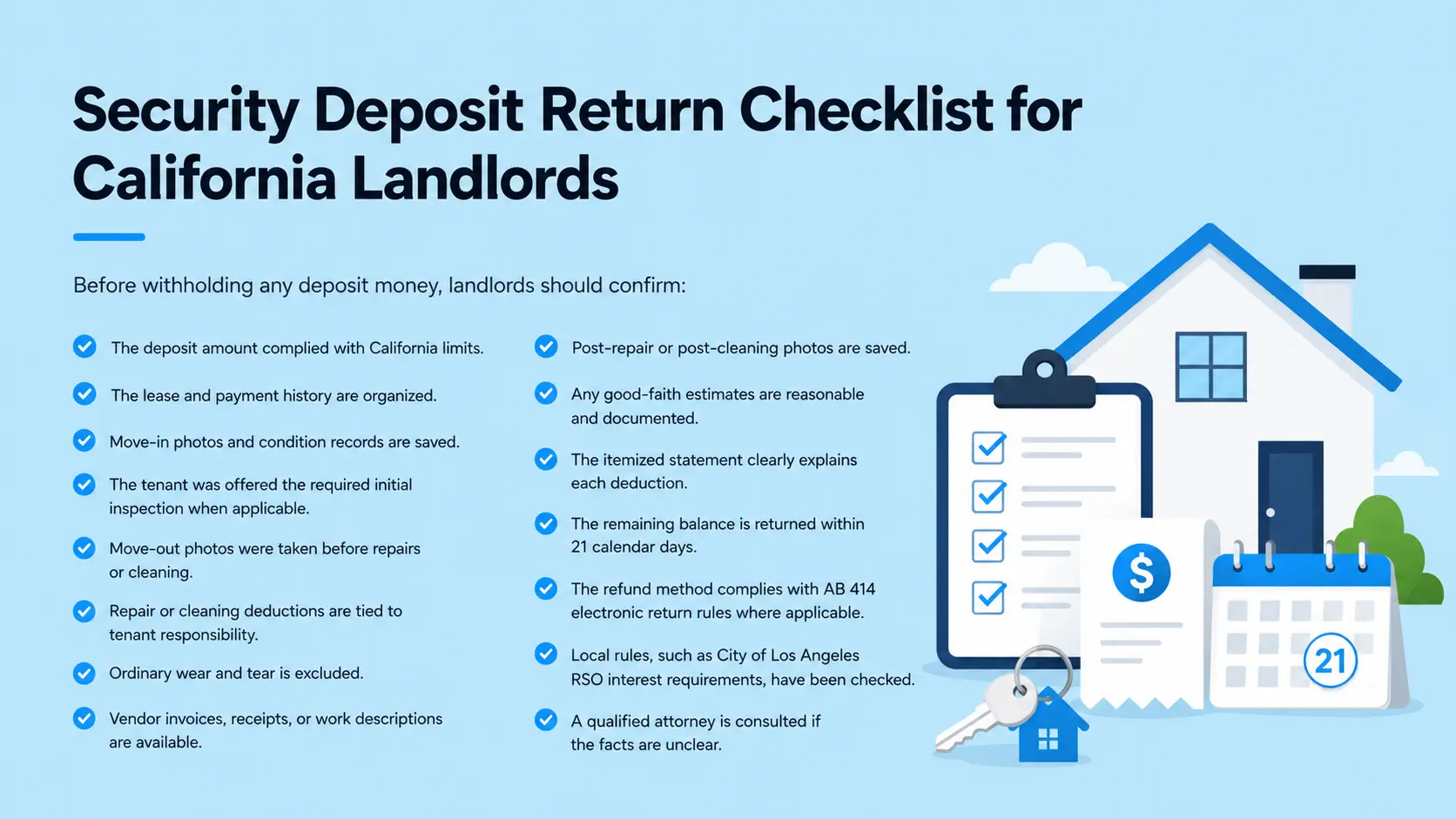
Open the image for a larger view, or download it to save for later.
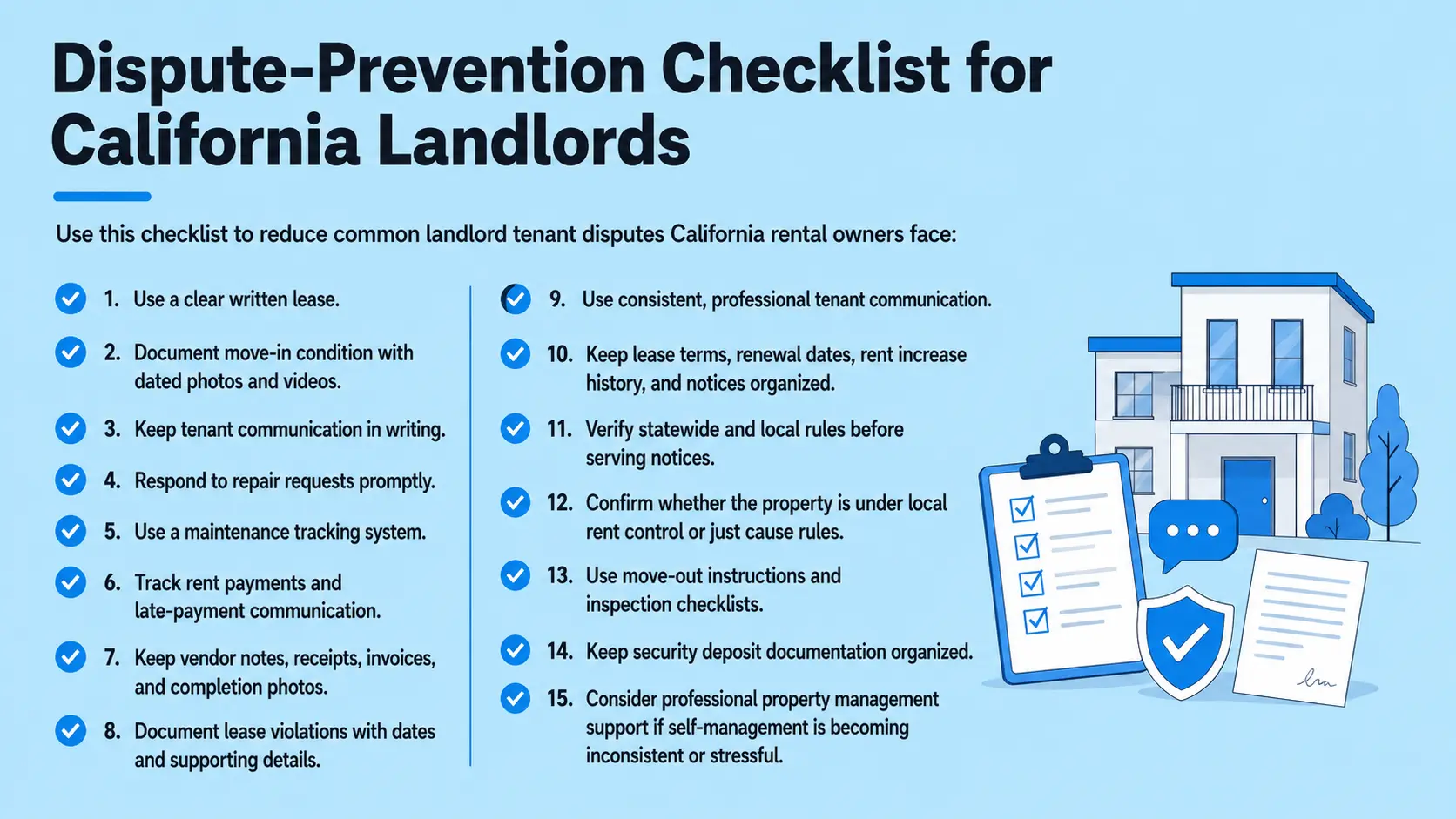
Open the image for a larger view, or download it to save for later.
What Los Angeles and Southern California Landlords Should Keep in Mind
California security deposit law is statewide, but Los Angeles and Southern California landlords often deal with local rental rules on top of state law. For owners managing rentals in Los Angeles, deposit handling is only one part of the broader Los Angeles rental law guide, especially when a property may be subject to rent stabilization, tenant protection rules, notice requirements, or local security deposit interest rules.
City of Los Angeles security deposit interest
For City of Los Angeles rental units subject to the Rent Stabilization Ordinance, LAHD states that landlords must pay interest on security deposits held for at least one year. LAHD’s 2026 bulletin lists the 2026 interest rate as 3.03%. This local rule applies to covered units, not every rental in Los Angeles County. (Source)
LA County local-rule caution
LA County DCBA states that California state law does not require security deposit interest, but some local rent control laws do. DCBA also notes that fully covered rental units subject to unincorporated Los Angeles County’s Rent Stabilization and Tenant Protections Ordinance may not have the security deposit increased during the tenancy. (Source)
Landlord takeaway for Southern California owners
If you own a rental in Los Angeles, Pasadena, Glendale, Long Beach, Santa Monica, Burbank, Torrance, West Hollywood, or elsewhere in Southern California, check both statewide law and local rules. Security deposit compliance is not just about the California Civil Code. Local rent stabilization rules, deposit interest rules, and tenant protection rules may also affect your process.
DirectPads Expert Insight
From a property management perspective, many deposit disputes are not really about whether the damage existed. They are about whether the landlord can prove the condition of the property, the timing of the damage, the reason for the deduction, and the cost of the repair.
A self-managing landlord may know the tenant damaged the property. But knowing and proving are different. Without move-in photos, move-out photos, invoices, written communication, repair notes, and a clear timeline, a reasonable deduction can still become difficult to explain.
The practical takeaway for California landlords is this: security deposit compliance starts before the tenant gets the keys.
That means:
- Document the property before move-in.
- Keep maintenance records during the tenancy.
- Communicate in writing.
- Offer the pre-move-out inspection when required.
- Take photos before repairs or cleaning.
- Save invoices and receipts.
- Send a clear itemized statement.
- Return the balance on time.
- Use the correct refund method.
This is property management insight, not legal advice. Owners should verify current requirements with official sources or a qualified attorney before making deposit deductions or legal decisions.
How DirectPads Helps Landlords With Security Deposit Workflows
DirectPads helps Southern California rental property owners manage the operational side of security deposit compliance. DirectPads is not a law firm and does not provide legal advice, but it helps owners stay organized around the workflows that often determine whether a deposit deduction is easy or difficult to support.
DirectPads can help with:
- Move-in documentation.
- Move-out coordination.
- Tenant communication.
- Maintenance coordination.
- Vendor coordination.
- Inspection workflows.
- Photo and documentation systems.
- Rent collection.
- Owner reporting.
- Leasing support.
- Day-to-day property management.
For Los Angeles County landlords, ADU owners, condo owners, inherited-property owners, and small investors, the value is structure. Instead of scattered texts, photos, invoices, and notes, DirectPads helps create a more organized management process from lease signing to move-out.
Need Help Managing a Rental Property in Southern California?
If you own a rental property in Los Angeles County or Southern California and want help with tenant communication, maintenance coordination, inspections, move-in and move-out documentation, rent collection, and day-to-day rental management, DirectPads can help you manage your property with more clarity and less stress.
Security deposits are not just about returning money. They are about documentation, timing, communication, and process. DirectPads helps landlords build better systems around the parts of rental ownership that often create disputes.
If you want a practical, flat-rate, technology-driven property management partner for your Southern California rental, DirectPads can help.
FAQ: California Security Deposit Laws 2026
How much can a California landlord charge for a security deposit in 2026?
Most California residential landlords generally cannot charge more than one month’s rent as a security deposit, in addition to first month’s rent paid before occupancy. A limited small-landlord exception may allow up to two months’ rent if specific requirements are met, but that exception does not apply to prospective tenants who are service members. (Source)
How long does a landlord have to return a security deposit in California?
A landlord generally has 21 calendar days after the tenant vacates to return the full deposit or return the remaining balance with an itemized statement explaining deductions. (Source)
What can a landlord deduct from a security deposit in California?
A landlord may generally deduct for past-due rent, tenant-caused damage beyond ordinary wear and tear, cleaning needed to return the unit to move-in cleanliness, and restoration or replacement of personal property if authorized by the rental agreement. (Source)
Can a landlord deduct for cleaning in California?
Yes, but only when cleaning is necessary to return the rental unit to the same level of cleanliness it was in at the beginning of the tenancy. Professional cleaning should not be treated as an automatic deduction. (Source)
Can a landlord charge for professional carpet cleaning in California?
Only if professional carpet cleaning is reasonably necessary to return the premises to the condition it was in at the beginning of the tenancy, excluding ordinary wear and tear. (Source)
What is normal wear and tear in a California rental?
Normal wear and tear is ordinary deterioration from normal use, age, and time. Examples may include light scuffs, fading paint, or worn carpet in normal traffic areas. Landlords should not deduct for ordinary wear and tear, preexisting conditions, or cumulative ordinary wear. (Source)
What are California’s security deposit photo requirements?
For tenancies beginning on or after July 1, 2025, landlords must take move-in photos immediately before or at the start of the tenancy. Beginning April 1, 2025, landlords must also take photos after possession is returned but before repairs or cleaning tied to deductions, and again after those repairs or cleaning are completed. (Source)
What did AB 414 change for California security deposit returns?
AB 414 updated the return method rules. If the landlord received the security deposit or rent electronically, the remaining deposit may need to be returned electronically unless the landlord and tenant have a written agreement designating another method. (Source)
Do Los Angeles landlords have to pay interest on security deposits?
State law does not generally require security deposit interest, but some local laws do. For City of Los Angeles RSO-covered units, LAHD states that landlords must pay interest on security deposits held for at least one year, and LAHD’s 2026 bulletin lists the 2026 rate as 3.03%. (Source)
What should landlords do before withholding part of a security deposit?
Before withholding deposit money, landlords should confirm the deduction is legally allowed, compare move-in and move-out condition records, take required photos, collect receipts or invoices, prepare a clear itemized statement, return the remaining balance on time, and verify whether AB 414 electronic refund rules apply.
Legal Disclaimer
This article is for general informational purposes only and is not legal advice. Security deposit rules and rental laws can change and may vary based on property type, lease terms, local rules, tenant status, ownership structure, payment method, move-out facts, and other circumstances. Property owners should verify current requirements with official sources or a qualified attorney before making deposit deductions or legal decisions.