
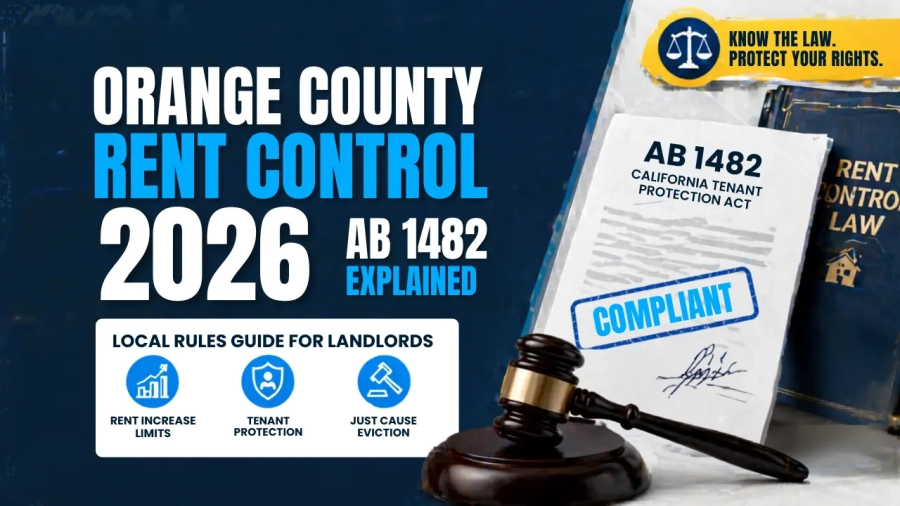
Orange County Rent Control 2026

Orange County Rent Control 2026: AB 1482 Explained + Local Rules Guide for Landlords

Orange County Rent Control 2026: AB 1482 Explained + Local Rules Guide for Landlords

Table of Contents

    Why Orange County Rent Control Is More Complicated Than You Think

    If you’ve been hearing that Orange County has “no rent control,” you’re only getting part of the story. That assumption can cause landlords to miss important state and local rules, and pay for it later.

    The reality in 2026 is more nuanced. While Orange County does not have one countywide rent-control ordinance, many landlords are still governed by California’s statewide law, AB 1482. On top of that, cities like Santa Ana and Costa Mesa have local tenant protections that can affect how you manage your property. 

    This creates a layered system. And unless you understand how those layers interact, it’s easy to make costly mistakes, especially when raising rent or handling tenant turnover.

    This guide breaks down key issues clearly, so you can manage risk with more confidence.

    The Truth About Rent Control in Orange County

    Orange County does not have a countywide rent control ordinance, so there is no single rule that caps rent increases across all cities. However, many rental properties in the county are still covered by California’s Tenant Protection Act, also known as AB 1482, unless a specific exemption applies.

    Here’s how it works in practice:

    • AB 1482 applies to many residential rental properties statewide, but some units are exempt based on factors like property type, age, ownership structure, or required notice.
    • Some Orange County cities have their own tenant protections, and Santa Ana has a local rent stabilization and just-cause ordinance for covered units.
    • Other local, emergency, or special-purpose rules may also affect rent increases when they apply.

    So while Orange County does not have one countywide rent board, landlords and tenants may still be operating under state and local rent regulations.

    Understanding AB 1482: The Law That Shapes Everything

    AB 1482, also known as the Tenant Protection Act, has been the backbone of statewide rent regulation in California since 2020. By 2026, it remains one of the most important laws Orange County landlords need to understand.

    At its core, AB 1482 does two things:

    • Limits how much you can raise rent
      ● Restricts when and how you can terminate many covered tenancies

    These protections apply to many, but not all, rental properties. Knowing whether your property is covered is essential before making any decisions. 

    Rent Increase Limits in 2026: How Much Can You Raise Rent?

    The rent cap under AB 1482 follows a simple formula, but the real-world application can be confusing if you’re not familiar with CPI adjustments.

    For covered units, the law limits rent increases to the lesser of 5% plus the local CPI or 10% total over a 12-month period. The increase is measured against the lowest gross rental rate charged for the unit during the 12 months before the effective date of the increase.  

    5% + CPI, capped at 10%

    This means your increase is:

    • 5% base increase
      ● Plus the applicable local Consumer Price Index
      ● But never more than 10% total

    What This Looks Like in Orange County

    Orange County falls under the Los Angeles-Long Beach-Anaheim CPI region. For AB 1482 rent increases effective August 1, 2025 through July 31, 2026, the Los Angeles area CPI-U change was 3.0%, which makes the current AB 1482 cap 8.0% for covered Orange County units.  

    For example, if your tenant pays $2,500 per month:

    • An 8% increase equals $200
      ● New rent becomes $2,700

    It’s straightforward on paper, but timing matters. The law applies over a rolling 12-month period, not just calendar years.

    For rent increases effective August 1, 2026 or later, landlords should verify the new CPI figure before issuing notices. AB 1482 uses April CPI data, or March data if April is unavailable, depending on when the rent increase takes effect. 

    The 12-Month Rule Most Landlords Overlook

    One of the most common mistakes landlords make is misunderstanding how often rent can be increased.

    AB 1482 allows no more than two rent-increase increments in any 12-month period for the same tenant, and the combined increase must stay within the legal cap. 

    This means you could technically:

    • Raise rent twice in one year
      ● But the combined increase cannot exceed the allowed percentage
      ● And local rules may be stricter

    This detail is often overlooked, especially by newer landlords trying to adjust pricing more frequently.

    Which Properties Are Covered by AB 1482?

    Not every property is covered by AB 1482 or local rent-control rules. But many landlords assume they’re exempt when they’re not.

    In general, AB 1482 may apply to:

    • Apartment buildings
      ● Multi-family housing
      ● Rental units that are more than 15 years old under the rolling construction-date test
      ● Corporate-owned single-family homes
      ● Certain condos or single-family homes that do not meet the required exemption conditions

    The age of the property is critical. If your building is more than 15 years old under the rolling construction-date test, it may fall under AB 1482, even if it was previously exempt.  

    Properties That Are Exempt: And Why It Matters

    There are several important exemptions, but they come with conditions.

    A property may be exempt only if the required conditions are met. Examples include:

    • A qualifying single-family home or condo where all ownership and notice requirements are met
      ● Housing issued a certificate of occupancy within the previous 15 years
      ● Certain qualifying owner-occupied duplexes
      ● Qualifying deed-restricted or government-regulated affordable housing
      ● Dormitories owned and operated by certain schools or institutions

    However, exemptions aren’t automatic. In many cases, landlords must provide written notice to tenants confirming the exemption. Failing to do this can create compliance problems with your exemption claim.  

    Just Cause Eviction Rules: A Major Shift for Landlords

    Rent caps are only part of AB 1482. The law also introduced “just cause” eviction requirements, which significantly changed landlord-tenant dynamics.

    After a tenant has continuously and lawfully occupied the unit for 12 months, you generally cannot terminate the tenancy without a valid reason. Special rules may apply when additional adult tenants are added. 

    At-fault reasons include:

    • Failure to pay rent
      ● Material lease violations
      ● Nuisance or waste
      ● Certain criminal or unlawful activity
      ● Refusal to allow lawful entry
      ● Unauthorized assignment or subletting

    No-fault reasons include:

    • Qualifying owner move-in
      ● Demolition or substantial remodel
      ● Removing the property from the rental market
      ● Compliance with certain government or court orders

    In AB 1482 no-fault cases, landlords are generally required to provide relocation assistance or a final-month rent waiver equal to one month of the tenant’s rent. Local rules may require more. 

    SB 567 Updates Landlords Should Know

    California strengthened several AB 1482 rules through SB 567, with important changes effective April 1, 2024.

    For owner move-in terminations, the owner or qualifying relative generally must move into the unit within 90 days after the tenant leaves and occupy it as a primary residence for at least 12 consecutive months. The notice must also include the intended occupant’s name and relationship to the owner. 

    For substantial remodel terminations, cosmetic improvements alone do not qualify. The work generally must involve major permitted structural, electrical, plumbing, or mechanical work, or hazardous-material abatement, and must require the tenant to vacate for at least 30 consecutive days

    Local Rules in Orange County: What’s Changing in 2026

    Even though Orange County doesn’t enforce one countywide rent-control ordinance, local policies matter.

    Santa Ana has adopted rent stabilization, a rental registry, and just-cause eviction protections for covered units. For September 1, 2025 through August 31, 2026, Santa Ana’s maximum allowable rent increase is 2.42% for covered units.

    Costa Mesa has also adopted tenant protections that can require just-cause documentation and relocation assistance greater than state law for qualifying no-fault terminations. 

    Other Orange County cities may have fewer local rent-control rules, but state law can still apply.

    This creates a patchwork of regulations. Two properties just miles apart may operate under different expectations.

    How State and Local Laws Work Together

    Understanding how laws interact is crucial.

    Think of it this way:

    1. Stricter valid local rent caps or just-cause protections may apply first
    2. State law, including AB 1482, may apply where no stricter local rule controls
    3. Federal rules and emergency price-gouging protections may impose additional limits when applicable

    If a city has a stricter valid rent cap, that local cap may control for covered units in that city. That’s why staying updated isn’t optional, it’s part of responsible property management.

    The Role of Costa-Hawkins: Why Rent Control Has Limits

    One reason local rent control has limits in California is the Costa-Hawkins Rental Housing Act.

    This law limits certain forms of local rent regulation. It generally restricts local rent control from applying to many separately alienable single-family homes, many condominiums, and housing with certificates of occupancy issued after February 1, 1995. 

    Costa-Hawkins is also connected to vacancy decontrol, which generally allows landlords to set the initial rent for a new tenancy when no prior tenant remains. However, state, local, subsidized-housing, and unusual termination-related exceptions can still matter.

    Rent Increase Notices

    Rent increases must be given in writing. A call, text, or casual email is not enough.

    For residential rent increases of 10% or less, landlords generally must provide at least 30 days’ notice. For rent increases greater than 10%, landlords generally must provide at least 90 days’ notice.

    Even when the increase is within the AB 1482 cap, the notice still needs to be handled correctly.

    Common Mistakes That Can Cost You Thousands

    Even experienced landlords make errors when navigating rent control laws. And in California, those mistakes can get expensive quickly.

    Some of the most common issues include:

    • Raising rent beyond the legal cap
      ● Using the wrong CPI period
      ● Forgetting to track cumulative increases
      ● Misidentifying exempt properties
      ● Skipping required written notices
      ● Ignoring local ordinances
      ● Treating “major renovations” as substantial remodels when they do not qualify

    Tenants are increasingly aware of their rights. Violations can lead to disputes, legal action, rent refunds, attorney’s fees, or other remedies. 

    Practical Strategies for Staying Compliant

    Navigating rent control doesn’t have to feel restrictive. In fact, many landlords use it as a framework for smarter decision-making.

    Instead of focusing only on maximum increases, consider long-term stability.

    For example, gradual rent adjustments often lead to better tenant retention. And reliable tenants can be more valuable than short-term rent gains.

    Keeping detailed records also makes a big difference. Documentation protects you if disputes arise and helps you stay aligned with legal requirements.

    Before issuing a rent increase or termination notice, confirm:

    • Whether AB 1482 applies
      ● Whether a local ordinance applies
      ● Whether an exemption is properly documented
      ● Whether the rent cap is calculated using the right CPI period
      ● Whether the notice language and timing are correct
      ● Whether relocation assistance is required
      ● Whether the issue should be reviewed by a California attorney

    What Happens If AB 1482 Changes or Expires?

    As of 2026, AB 1482 remains in effect until January 1, 2030, unless extended or changed. This uncertainty has created concern among landlords and investors. 

    There are a few possible outcomes:

    • The law is extended in its current form
      ● Rent caps become stricter
      ● More authority shifts to local governments
      ● Additional city-level protections are introduced

    Given ongoing state and local housing-policy activity, landlords should expect rules to continue changing.

    That makes preparation essential. Landlords who understand the system now will adapt more easily to future changes.

    Final Thoughts: Navigating Rent Control With Confidence

    Orange County rent control isn’t defined by a single rule, it’s shaped by a combination of statewide protections, local policies, exemptions, notice rules, and evolving regulations.

    Once you understand how AB 1482 works, the system becomes much more manageable.

    The key is staying informed, tracking changes, and making decisions based on long-term strategy rather than short-term reactions.

    When approached carefully, compliance can help protect your rental business from avoidable risk.

    Work With a Property Manager Who Actually Makes This Easy

    Understanding Orange County rent control is one thing, managing it day-to-day is another.

    Between tracking CPI increases, staying compliant with AB 1482, handling tenant issues, coordinating maintenance, and keeping up with changing local rules, it can quickly turn into a full-time job. And for most landlords, that’s not the goal.

    That’s where the right property management partner makes a difference.

    DirectPads was built specifically to take this complexity off your plate, without taking away your control.

    Instead of juggling everything yourself, you get a streamlined system where:

    • Your property is professionally marketed across top rental platforms
      ● Applicants are screened using consistent, legally compliant criteria, including permitted credit, background, income, and rental-history checks
      ● Rent collection and owner disbursements are handled quickly, subject to payment method and bank processing times
      ● Maintenance is handled efficiently with vetted vendors and transparent pricing
      ● You receive clear financial reports and real-time updates through your owner portal

    Tenant screening should always be handled consistently and in compliance with fair housing and consumer-reporting laws.

    And unlike many traditional property managers, you’re never locked into a rigid contract or hit with hidden fees.

    You still make the final decisions.
    You still control your property.
    You just don’t have to deal with the day-to-day stress.

    Ready to Simplify Your Rental Management?

    If you want stronger systems, fewer headaches, and more support managing your rental property, it might be time to stop doing everything yourself.

    Let DirectPads handle the work, so you can focus on growing your investment, not managing it.

    Get started today and see how easy rental ownership can be when everything is finally handled for you.

    FAQs About Orange County Rent Increases and AB 1482 in 2026

    What is the maximum rent increase allowed in Orange County in 2026?

    For covered AB 1482 units in Orange County, the cap is 8.0% for rent increases effective August 1, 2025 through July 31, 2026. For increases effective August 1, 2026 or later, landlords should verify the updated CPI before issuing notice.

    Do all rental properties fall under AB 1482?

    No. Some properties are exempt, including certain single-family homes or condos, newer construction, qualifying owner-occupied duplexes, and certain affordable housing. However, many landlords mistakenly assume exemption without meeting all legal requirements.

    Can I raise rent multiple times in one year?

    Yes, but AB 1482 allows no more than two increments in a 12-month period for the same tenant, and the combined increase must stay within the legal cap.

    What qualifies as a no-fault eviction?

    No-fault evictions include situations like qualifying owner move-in, demolition or substantial remodel, removing the unit from the rental market, or complying with certain government or court orders. These typically require relocation assistance for tenants.

    Can I reset rent after a tenant moves out?

    Often, yes. Landlords can generally set initial rent for a new tenancy when no prior tenant remains, subject to state, local, and subsidized-housing exceptions.
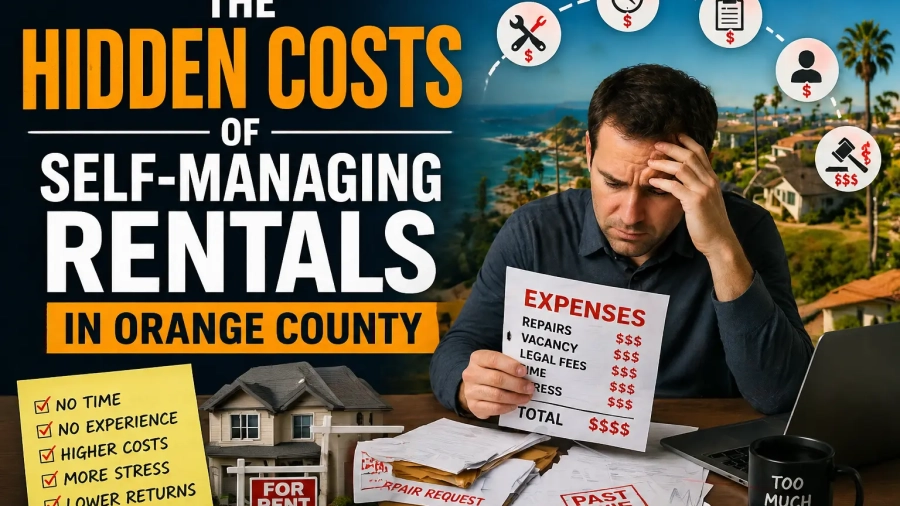

    The Hidden Costs of Self-Managing Rentals in Orange County

    The Hidden Costs of Self-Managing Rentals in Orange County (2026 Landlord Guide)

    The Hidden Costs of Self-Managing Rentals in Orange County (2026 Landlord Guide)

    Table of Contents

      Introduction

      At first glance, self-managing rental property in Orange County feels like the obvious choice. Why pay a property manager a percentage of your rent when you can handle things yourself?

      That logic makes sense, until the hidden costs start showing up.

      They don’t arrive as a single bill. Instead, they appear quietly through longer vacancies, unexpected repairs, legal missteps, and hours of your time that go unaccounted for. Over time, these “invisible” expenses can outweigh what you thought you were saving.

      This guide takes a deeper look at those hidden costs, not just listing them, but explaining how they impact your bottom line in a real-world Orange County context.

      Why Orange County Is a High-Stakes Rental Market

      Orange County isn’t your average rental market. Property values are high, tenant expectations are even higher, and regulations in California are among the strictest in the country.

      That combination creates opportunity, but also risk.

      A small mistake here doesn’t cost a few hundred dollars. It can cost thousands. Pricing your unit incorrectly, for example, doesn’t just affect one month, it affects your annual income and long-term returns.

      Because of this, landlords in Orange County operate in a tighter margin for error. The better the market, the less room there is for inefficiency.

      The Real Cost of Your Time

      Time is the first hidden cost most landlords overlook.

      Managing a property isn’t just collecting rent once a month. It involves constant communication, coordinating repairs, handling tenant concerns, and staying compliant with regulations.

      Even a relatively smooth rental can take 10–15 hours per month. That includes:

      • Answering tenant messages
      • Scheduling maintenance
      • Managing listings and inquiries
      • Keeping financial records

      Now consider what your time is worth. If you value your time at $50/hour, that’s $500–$750 per month in “invisible” labor.

      Over a year, that adds up quickly, and that’s assuming everything runs smoothly.

      Vacancy Loss: The Silent Profit Drain

      Vacancy is one of the most expensive problems in real estate, and it’s often underestimated.

      Every day your property sits empty, you’re losing money. In Orange County, where rents often exceed $3,000 per month, even a short vacancy becomes significant.

      A single month without a tenant could mean:

      • $3,000–$4,000 in lost income
      • Additional marketing expenses
      • Utility costs while the unit is empty

      Many self-managing landlords struggle here because filling vacancies requires more than posting on one listing site. It involves pricing strategy, high-quality marketing, and fast response times.

      A delay of even two weeks can cost more than a full year of property management fees.

      Pricing Mistakes That Cost Thousands

      Setting the right rent price is more complex than it seems.

      Price too high, and your property sits vacant. Price too low, and you leave money on the table every single month.

      For example, underpricing your rental by just $200 per month results in:t

      • $2,400 in lost income annually

      And overpricing can be even worse if it leads to extended vacancy.

      Professional managers rely on real-time market data and trends. Many DIY landlords rely on outdated listings or rough estimates, which leads to costly miscalculations.

      Tenant Screening Risks and Consequences

      A bad tenant can undo months, or even years, of profit.

      Screening isn’t just about checking credit scores. It involves verifying income, reviewing rental history, and identifying potential red flags.

      When screening is rushed or incomplete, landlords risk:

      • Missed rent payments
      • Property damage
      • Legal complications during eviction

      In California, eviction is not only expensive, it’s time-consuming. One mistake in the process can delay everything further.

      This is one area where cutting corners can have the highest financial impact.

      Maintenance Inefficiencies and Vendor Costs

      Maintenance is unavoidable. The question is how efficiently it’s handled.

      Self-managing landlords often lack a reliable network of contractors, which leads to:

      • Higher repair costs
      • Delays in fixing issues
      • Inconsistent quality of work

      For example, a small plumbing issue that could cost $150 if handled early might turn into a $1,000 repair if delayed.

      Tenants also expect quick responses. Slow maintenance not only increases costs but can lead to dissatisfaction, and eventually, turnover.

      Legal Risks in California Rental Laws

      California rental laws are detailed and constantly evolving.

      From security deposit rules to eviction procedures, there’s little room for error. A simple mistake, like using the wrong notice format, can invalidate your entire process.

      Common legal risks include:

      • Improper lease agreements
      • Fair housing violations
      • Mishandling deposits
      • Incorrect eviction notices

      These aren’t just technical issues. They can lead to fines, lawsuits, or prolonged vacancies.

      For many landlords, legal compliance becomes one of the most stressful aspects of self-management.

      The Cost of Being “Always On Call”

      When you self-manage, you’re not just a landlord, you’re also customer support.

      Tenants expect timely responses, regardless of the hour. Emergencies don’t wait for business hours, and neither do urgent maintenance issues.

      This means:

      • Late-night calls
      • Weekend interruptions
      • Constant availability

      While this doesn’t show up on a financial statement, it has a real cost. Over time, it leads to burnout, slower decision-making, and reduced efficiency.

      Turnover Costs Add Up Quickly

      Tenant turnover is more than just finding a new renter.

      Each transition involves multiple steps:

      • Cleaning and repairs
      • Listing and marketing
      • Screening new applicants
      • Potential vacancy time

      Even in a best-case scenario, turnover can cost one full month’s rent.

      Frequent turnover also disrupts cash flow and increases wear and tear on the property.

      Lack of Systems and Operational Inefficiency

      Professional property managers rely on systems to streamline operations. Self-managing landlords often rely on manual processes.

      Without systems in place, tasks take longer and errors become more likely.

      For example:

      • Manual rent collection increases late payments
      • Disorganized records create tax-time stress
      • Missed maintenance requests lead to bigger repairs

      Efficiency isn’t just about saving time, it directly impacts profitability.

      Emotional Stress and Decision Fatigue

      Not all costs are financial.

      Dealing with tenants, handling disputes, and making constant decisions can be mentally exhausting.

      Over time, this stress can lead to:

      • Poor decision-making
      • Delayed responses
      • Reduced overall performance as a landlord

      This is one of the most overlooked aspects of self-management, yet it affects everything else.

      Self-Managing vs Property Management: A Real Comparison

      At first glance, self-managing seems cheaper because there’s no monthly fee.

      But when you factor in hidden costs, the picture changes.

      Self-managing often includes:

      • Higher vacancy rates
      • Increased maintenance costs
      • Time investment
      • Legal risks

      Property management, on the other hand, introduces a fee, but reduces many of these risks.

      In many cases, landlords find that professional management actually improves their net income over time.

      How to Reduce Hidden Costs (Even If You DIY)

      If you choose to self-manage, there are ways to minimize these risks.

      Focus on building systems and staying proactive.

      • Use data-driven pricing tools to stay competitive
      • Invest in thorough tenant screening
      • Build relationships with reliable contractors
      • Stay updated on California rental laws
      • Automate rent collection and communication

      These steps won’t eliminate all hidden costs, but they can significantly reduce them.

      Conclusion

      Self-managing rental property in Orange County can work, but only if you fully understand what it truly costs.

      The biggest mistake landlords make is focusing only on visible expenses while ignoring the hidden ones. Over time, those hidden costs, vacancies, inefficiencies, legal risks, and lost time, can quietly erode your profits.

      The goal isn’t just to save money. It’s to maximize your return while minimizing stress and risk.

      For many landlords, that means rethinking whether self-management is really the most cost-effective option.

      Ready to Maximize Your Rental ROI?

      If you want to reduce vacancies, avoid costly mistakes, and simplify property management, it may be time to explore a smarter approach.

      DirectPads helps landlords streamline leasing, attract better tenants, and improve overall efficiency, without the complexity of traditional management.

      👉 Take control of your rental income and eliminate hidden costs with DirectPads Contact Us Today!

      FAQs About the Hidden Costs of Self-Managing Rentals

      What is the biggest hidden cost of self-managing rentals?

      The biggest hidden cost is time. Many landlords spend 10–15 hours per month managing tasks, which translates into thousands of dollars annually when you assign a value to that time.

      How do vacancies impact rental profitability?

      Vacancies directly reduce income. In high-rent markets like Orange County, even a two-week vacancy can cost over $1,500, making it one of the most significant hidden expenses.

      Are property managers worth the cost?

      In many cases, yes. While they charge a percentage of rent, they often reduce vacancy rates, improve tenant quality, and prevent costly mistakes, which can increase overall profitability.

      How can landlords reduce maintenance costs?

      Preventive maintenance and having a reliable vendor network are key. Addressing issues early and working with trusted contractors can significantly reduce long-term repair expenses.

      Is self-managing suitable for new landlords?

      It can be challenging for beginners. Without experience in pricing, screening, and legal compliance, new landlords are more likely to encounter costly mistakes early on.

      Top Mistakes First-Time Orange County Landlords Make & How To Avoid Them

      Top Mistakes First-Time Orange County Landlords Make (2026 Guide)

      Top Mistakes First-Time Orange County Landlords Make

      Table of Contents

        Introduction: The Reality Behind Rental Income

        Owning a rental property in Orange County often looks like a straightforward path to passive income. With high demand, desirable neighborhoods, and strong appreciation, it’s easy to assume success is almost guaranteed.

        But many first-time landlords quickly discover that reality is more complicated.

        Unexpected repairs, difficult tenants, legal restrictions, and pricing mistakes can quietly eat into profits. In some cases, new landlords end up losing money, not because real estate is a bad investment, but because they weren’t fully prepared for the responsibilities that come with it.

        This guide takes a closer look at the most common mistakes first-time Orange County landlords make. More importantly, it explains how to avoid them with practical, real-world strategies that actually work.

        Why Orange County Is a Unique Rental Market

        Orange County isn’t just any rental market. It operates at a different level compared to many other regions in the U.S.

        Property prices are high, tenant expectations are even higher, and California property management laws add an extra layer of complexity. A small mistake here can cost significantly more than it would elsewhere.

        There’s also strong competition. Tenants have options, which means your pricing, property condition, and responsiveness all directly affect whether your unit stays occupied.

        Understanding this environment is key. The landlords who succeed are the ones who treat their rental like a business, not a side project.

        The Most Common Mistakes First-Time Landlords Make

        Not Fully Understanding California Rental Laws

        One of the fastest ways to run into trouble is overlooking legal requirements.

        California has strict rules covering everything from rent increases to eviction procedures. For example, rent control laws like AB 1482 limit how much you can increase rent annually, and improper eviction notices can delay the process by months.

        It’s not uncommon for new landlords to rely on outdated information or generic lease templates. That can lead to violations without even realizing it.

        Taking time to understand local regulations, or working with a professional, can prevent costly legal issues later.

        Rushing the Tenant Screening Process

        When a property sits vacant, it creates pressure to fill it quickly. That urgency often leads to rushed decisions.

        But choosing the wrong tenant is one of the most expensive mistakes you can make.

        A reliable screening process should include:

        • Verifying income and employment
        • Checking credit history
        • Reviewing past rental behavior

        For example, a tenant with inconsistent income might seem fine at first, but could struggle to pay rent consistently. Small oversights like this often turn into bigger problems down the line.

        Setting the Wrong Rental Price

        Pricing a rental property is more nuanced than many expect.

        Set the rent too high, and you risk long vacancy periods. Set it too low, and you leave money on the table every month.

        In Orange County, even a slight miscalculation can mean losing thousands annually.

        Instead of guessing, successful landlords study comparable listings, track local demand, and adjust pricing based on market conditions. A well-priced unit not only attracts tenants faster but also reduces turnover.

        Underestimating the True Cost of Ownership

        Many first-time landlords focus heavily on rental income but overlook the full cost of maintaining a property.

        Expenses don’t just include mortgage payments. There are also:

        • Routine maintenance
        • Unexpected repairs
        • Insurance and property taxes
        • Vacancy periods

        For instance, a plumbing issue or HVAC failure can quickly turn into a four-figure expense. Without proper budgeting, these surprises can disrupt cash flow.

        Planning ahead with a financial buffer makes a significant difference.

        Neglecting Preventative Maintenance

        It’s easy to delay small repairs, especially when everything seems to be working fine.

        But minor issues rarely stay minor.

        A small leak can turn into water damage. An aging appliance can fail unexpectedly. These problems not only cost more to fix later but can also frustrate tenants.

        Regular inspections and timely maintenance help avoid larger expenses and keep tenants satisfied. It’s one of the simplest ways to protect both your property and your reputation.

        Using Weak or Generic Lease Agreements

        A lease agreement is more than just a formality, it’s your primary layer of protection.

        Generic templates often miss important details specific to California or Orange County. This can lead to misunderstandings about responsibilities, payments, or property use.

        A strong lease clearly outlines expectations for both parties. It reduces disputes and gives you a solid foundation if issues arise.

        Using Weak or Generic Lease Agreements

        A lease agreement is more than just a formality, it’s your primary layer of protection.

        Generic templates often miss important details specific to California or Orange County. This can lead to misunderstandings about responsibilities, payments, or property use.

        A strong lease clearly outlines expectations for both parties. It reduces disputes and gives you a solid foundation if issues arise.

        Using Weak or Generic Lease Agreements

        Many people enter real estate expecting minimal involvement.

        In reality, being a landlord, especially at the beginning, requires time and attention.

        You may need to handle maintenance requests, coordinate repairs, respond to tenant concerns, and stay updated on legal requirements. Without systems in place, it can quickly become overwhelming.

        Some landlords eventually choose to work with property managers, while others build efficient processes to manage things themselves.

        Poor Communication with Tenants

        Communication plays a bigger role than most landlords expect.

        Delayed responses or unclear expectations can create frustration, even if the issue itself is minor. Over time, this affects tenant satisfaction and increases turnover.

        On the other hand, clear and timely communication builds trust. Tenants are more likely to renew leases and take better care of the property when they feel respected and heard.

        Ignoring Fair Housing Rules

        Fair housing laws are strict, and violations can lead to serious consequences.

        Sometimes, mistakes happen unintentionally. For example, asking the wrong questions during screening or applying inconsistent criteria can create legal risk.

        The safest approach is to treat every applicant the same and follow a consistent, documented process. This protects both you and your tenants.

        Waiting Too Long to Address Problem Tenants

        No landlord wants to deal with evictions. It’s stressful, time-consuming, and often expensive.

        However, delaying action when issues arise can make things worse.

        If a tenant repeatedly misses payments or violates lease terms, addressing it early is crucial. Waiting too long often leads to larger financial losses and more complicated legal situations.

        Failing to Adjust Rent Over Time

        Some landlords keep rent unchanged for years, even as the market shifts.

        While this might seem like a way to retain tenants, it can significantly reduce long-term income.

        Gradual, reasonable increases, within legal limits, help maintain profitability while keeping tenants in place. It’s about finding the right balance.

        Weak Property Marketing

        First impressions matter, especially in a competitive rental market.

        Listings with poor photos or vague descriptions tend to attract less interest. In some cases, they may also attract less qualified tenants.

        A strong listing highlights the property’s best features, uses clear photos, and provides enough detail to answer common questions upfront.

        This doesn’t just fill vacancies faster, it improves the quality of applicants

        Weak Property Marketing

        Not every property makes a good rental.

        Some first-time landlords choose properties based on emotion rather than numbers. A home might look appealing but have high maintenance costs or low rental demand.

        Successful investors focus on:

        • Location and rental demand
        • Expected maintenance costs
        • Long-term appreciation potential

        Making a data-driven decision at the start can prevent years of frustration.

        Trying to Handle Everything Alone

        Doing everything yourself might save money initially, but it often leads to burnout.

        Managing tenants, repairs, finances, and legal requirements can quickly become overwhelming, especially if you have other commitments.

        Outsourcing certain tasks or using management tools can make the process more manageable and reduce the risk of mistakes.

        Not Keeping an Emergency Fund

        Unexpected expenses are part of being a landlord.

        Without a financial cushion, even a single major repair can create stress or force difficult decisions.

        A reserve fund provides stability. It allows you to handle issues without disrupting your long-term plans.

        Skipping Regular Property Inspections

        Inspections aren’t just about checking for damage, they’re about staying informed.

        They help you identify issues early, ensure lease terms are being followed, and maintain the overall condition of the property.

        Even a simple walkthrough can reveal problems that would otherwise go unnoticed.

        Overlooking Tenant Retention

        Finding new tenants is more expensive than keeping existing ones.

        Turnover involves cleaning, repairs, marketing, and potential vacancy periods. All of these reduce your overall return.

        Small efforts, like timely maintenance, fair pricing, and respectful communication, can go a long way in encouraging tenants to stay.

        Not Using Technology to Simplify Management

        Technology has made property management much more efficient.

        Online rent collection, maintenance tracking, and tenant communication tools save time and reduce errors. They also create a better experience for tenants.

        Landlords who embrace these tools often find it easier to manage multiple responsibilities without feeling overwhelmed

        What Successful Orange County Landlords Do Differently

        The difference between struggling landlords and successful ones often comes down to preparation and mindset.

        Successful landlords treat their rental property as a business. They rely on data instead of guesswork, stay informed about legal changes, and build systems that make management more efficient.

        They also focus on long-term performance rather than short-term gains. Instead of cutting corners, they invest in maintenance, tenant relationships, and smart pricing strategies.

        Over time, these small decisions add up to consistent income and property appreciation.

        Conclusion: Turning Mistakes Into Opportunities

        Every first-time landlord makes mistakes, it’s part of the learning process.

        The key is minimizing costly errors and learning quickly from experience.

        Orange County offers strong opportunities for rental income, but success requires a thoughtful approach. Understanding the market, managing risks, and staying proactive can make all the difference.

        If you approach your rental property with the right mindset and strategies, it can become a reliable source of income for years to come.

        Being a landlord in Orange County shouldn’t feel like a second full-time job.

        If you’re tired of chasing rent, handling maintenance issues, screening tenants, or worrying about legal compliance, it may be time to hand it off to professionals who do this every day.

        With DirectPads, you get true full-service property management, without giving up control. From pricing your rental correctly and marketing it across major platforms, to thoroughly screening tenants, coordinating repairs, collecting rent, and handling inspections, everything is managed for you in one streamlined system.

        You’ll always stay in the loop and in control:

        • Approve tenants before placement
        • Set repair limits and decisions
        • Access real-time financial reports and updates
        • Receive fast payouts, often within 24–48 hours

        No hidden fees. No surprises. Just predictable income and peace of mind.

        👉 Get started with DirectPads today and turn your rental into a truly hands-off investment

        FAQs for First-Time Landlords in Orange County

        What is the most common mistake first-time landlords make?

        The most common mistake is inadequate tenant screening. Choosing the wrong tenant can lead to missed payments, property damage, and legal complications. A thorough and consistent screening process helps reduce these risks significantly.

        How do I determine the right rental price in Orange County?

        Start by analyzing comparable properties in your area. Look at similar size, location, and amenities. Pricing should reflect current market demand while remaining competitive enough to minimize vacancy.

        Do I need a property manager as a beginner?

        Not necessarily, but it can help. Property managers handle day-to-day tasks and legal compliance, which can reduce stress and prevent mistakes, especially for first-time landlords.

        How much should I budget for maintenance and repairs?

        A common recommendation is to set aside 10–20% of your rental income. This helps cover routine maintenance, unexpected repairs, and periods of vacancy without financial strain.

        How can I keep tenants long-term?

        Good communication, fair pricing, and consistent maintenance are key. When tenants feel respected and comfortable, they’re more likely to renew their lease and take care of the property.

        2026 California Property Management Laws: A Complete Guide for Landlords & Investors

        2026 California Property Management Laws | Complete Guide for Landlords & Investors

        2026 California Property Management Laws | Complete Guide for Landlords & Investors

        Updated for 2026: Key California landlord-tenant law changes property owners must prepare for, including habitability standards, disaster-related rent rules, security deposits, required disclosures, and compliance best practices.

        Table of Contents

          Introduction

          Property management in California is transforming rapidly. As 2026 begins, new statewide laws introduce major legal obligations that affect how property owners operate rental homes and investment properties. If you’re a landlord or real estate investor, understanding these changes isn’t optional, it’s essential for legal compliance, reducing liability, and protecting your rental income.

          This guide breaks down California’s 2026 rental law updates with clear explanations, practical landlord action steps, and the legal context you need to stay ahead of compliance. 

          Orange County Note:

          Cities like Santa Ana, Anaheim, and Irvine may enforce additional local tenant protections. Landlords must comply with both state law and any stricter local ordinances.

          Mandatory Appliances & Enhanced Habitability Standards

          AB 628: Kitchens Must Be Functional

          Effective January 1, 2026, residential rental units must include a working refrigerator and stove as part of basic habitability requirements. Historically considered “optional,” these appliances are now legally essential, with landlords responsible for providing and maintaining them in proper working order on new or renewed leases. 

          What property owners must do:

          • Ensure every qualifying rental provides a functional stove and refrigerator.
          • A landlord must repair or replace a stove or refrigerator that is subject to recall by the manufacturer or a public entity within 30 days of receiving notice of the recall.
          • If a tenant wants to use their own refrigerator, ensure a written opt-out agreement is included in the lease (with a 30-day written notice required to revert).
          • Recognize exemptions: permanent supportive housing, SRO with shared kitchens, residential hotels, and similar configurations are excluded.

            Why this matters: Lack of required appliances can expose landlords to habitability disputes and regulatory enforcement, increasing operational risk.

          Security Deposit Reform – AB 414

          California has modernized how deposits must be returned when leases end. Under AB 414, landlords must return security deposits within 21 days after the lease ends and provide a list of any deductions. Lease Termination Rules in Orange County are consistent with these state regulations, ensuring the same protection for tenants and landlords in the county.

          • If the landlord received a security deposit electronically (e.g., Zelle, Venmo, ACH), the refund must also be returned electronically unless both parties agree otherwise.
          • Landlords must provide itemized move-out statements, receipts, and photographic documentation of deductions.
          • For households with multiple adult tenants, refund routing rules and written delivery requirements are now standardized.

          Practical steps:

          • Update lease forms to reflect refund delivery preferences.
          • Build consistent photographic and digital documentation processes to support deductions and avoid disputes.

          New Tenant Opt-Out Protections – AB 1414

          Under AB 1414, landlords cannot force tenants to purchase or subscribe to bundled third-party services (e.g., internet, cable) as a condition of tenancy. If such charges are imposed without proper opt-out language or consent, tenants may deduct those fees from rent. 

          Action tip:
          Review and revise lease addenda and “other charges” disclosures to ensure fee transparency and legal opt-out language.

          Eviction Law Changes – Tenant Protections Expanded

          AB 246: Social Security Hardship Defense

          Effective January 1, 2026, tenants may use delayed or reduced Social Security benefits as a legal defense in nonpayment eviction cases,  pausing proceedings until benefits resume (up to six months). Rent still remains owed but courts can stay eviction and allow repayment plans. 

          AB 238 and related protections also mitigate eviction risk for tenants affected by disasters, further complicating eviction timelines. 

          Rent Pricing & Compliance – Algorithmic Pricing Alert

          New amendments under AB 325 and SB 763 focus on rent-setting practices: they prohibit coordinated rent increases driven by shared competitor data and impose significant fines under California’s antitrust laws. Documenting independent pricing decisions and strategies is now more critical than ever.

          Compliance tip: Maintain defendable pricing justification and avoid tools that share aggregated competitor data.

          Expanded Habitability: Natural Disaster Response – SB 610

          Senate Bill 610 increases landlord obligations after fires, floods, and other disasters:

          • Remove debris, smoke, and hazardous materials.
          • Ensure the unit meets safety and habitability standards before the tenant returns.
          • Rent obligations may be paused when units are uninhabitable. 

          This reflects California’s trend toward higher safety standards and occupant protection.

          Continued Rent Caps & Just Cause Requirements

          The Tenant Protection Act (AB 1482) continues providing rent increase limitations (max 5% + CPI, capped at 10%) and mandatory just-cause eviction standards through mid-2026. These remain foundational protections for most residential properties statewide.

          Court and Service Procedure Changes – AB 1384 & AB 747

          Recent procedural reforms require enhanced documentation in eviction filings and allow more flexible court scheduling, meaning landlords must have stronger proof of service, notices, and correspondence filings. 

          Understanding Notice Periods: Essential for California Landlords

          As California property management laws evolve in 2026, landlords need to follow specific notice rules when dealing with nonpayment of rent, rent increases, or the termination of a month‑to‑month tenancy. These notice requirements are meant to promote fair warning, proper documentation, and compliance with state law. However, landlords should remember that local rent‑control or eviction‑control ordinances may impose stricter rules than state law.

          3‑Day Notice for Unpaid Rent

          If rent is overdue, landlords must serve a 3‑day pay‑or‑quit notice. This notice must clearly state the amount owed and allow 3 full calendar days (not business days) for the tenant to either pay the rent in full or vacate the premises.

          30‑Day or 60‑Day Notice to End Tenancy

          For month‑to‑month tenants, a 30‑day notice is required if they’ve lived in the property for less than one year. A 60‑day notice is required for tenants who’ve been in the property for a year or more. After 12 months of continuous occupancy, state and many local laws also require that a landlord have a valid “just cause” reason to end the tenancy without cause. Local laws may have additional requirements, especially regarding just‑cause protections and documentation.

          Notice for Rent Increases

          If the rent increase is 10% or less over the past 12 months, a 30‑day notice is required. For cumulative increases greater than 10% within any 12‑month period, a 90‑day notice is required under state law for most covered units, though some local ordinances (for example, in certain cities or jurisdictions) may allow or require 60‑day notices instead. Landlords in these areas must follow the stricter local rule.

          Why It Matters

          Accurate notices help prevent legal issues and keep the rental process smooth. Always follow the proper procedure, including correct notice lengths, clear language, and any additional local‑ordinance requirements, to avoid complications or defenses in court.

          As California property management laws evolve in 2026, it’s important for landlords to understand the rules around notice periods. These timeframes are in place to protect both the tenant and the landlord, providing clear communication and a fair process when making changes to a rental agreement, such as ending a tenancy or raising rent.

          • 3-Day Notice for Unpaid Rent: If a tenant fails to pay rent, landlords must issue a 3-day notice to either pay the overdue rent or vacate the premises. This allows tenants a short window to address the issue and helps prevent unnecessary eviction proceedings.
          • 30-Day Notice for Tenants with Less Than One Year of Tenancy: For month-to-month tenants who have lived in the property for less than a year, landlords are required to give a 30-day notice if they intend to terminate the lease or increase the rent. This gives tenants time to make necessary adjustments and seek alternate housing if needed.
          • 60-Day Notice for Longer Tenancies: For tenants who have been in the property for over a year, landlords must provide a 60-day notice before making significant changes, like rent increases or lease terminations. This extended period offers long-term tenants a fair amount of time to plan their next steps.

          Proper documentation of these notices is essential to avoid legal disputes and ensure both parties are fully informed. With clear notice periods in place, landlords can prevent misunderstandings and minimize the risk of costly legal issues.

          Compliance Checklist for 2026

          ✔ Review and update all lease templates to reflect new rules
          ✔ Implement appliance verification and maintenance logs
          ✔ Establish electronic deposit return procedures
          ✔ Create transparent fee disclosures and tenant opt-out clauses
          ✔ Document pricing decisions and justification practices
          ✔ Train property management staff on new eviction protections
          ✔ Establish disaster recovery protocols and safety checklists

          For official guidance, enforcement updates, and ongoing compliance education, landlords are encouraged to consult resources published by the California Department of Real Estate (DRE).

          Conclusion

          2026 marks one of the most significant shifts in California rental law in years. From habitability upgrades and security deposit reforms, to expanded tenant defenses and pricing oversight, landlords must take proactive steps now to stay compliant and protect their investments.

          Staying informed and updating your systems, paperwork, and processes will ensure you’re ready, and legally prepared, for these changes.

          Need Help Navigating California’s 2026 Landlord Law Changes?

          If you own rental property in Orange County, Los Angeles County, or the Inland Empire, keeping up with 2026 compliance requirements can feel overwhelming, especially as laws continue to shift toward stricter enforcement.

          DirectPads helps Southern California landlords stay compliant, reduce legal exposure, and protect long-term rental income through professional property management and compliance-focused systems.

          👉 Talk to a DirectPads expert today and let us handle the details, so you don’t have to.

          FAQs About 2026 California Rental Laws

          Do all these 2026 laws apply to every rental in California?

          No, application varies by lease timing, property type, funding source, and local ordinance. Legal counsel can clarify specifics for your portfolio.

          What happens if I fail to provide a required appliance?

          Failure could lead to habitability violations, tenant complaints, and potential legal exposure.

          When must deposit refunds be sent electronically?

          Only when the initial deposit was received electronically unless otherwise agreed in writing.

          Does Social Security hardship stop rent from being owed?

          No, rent is still owed, but courts may pause eviction and allow repayment plans.

          Are rent increase caps still in place?

          Yes, AB 1482 limits rent increases statewide through mid-2026.

          Do 2026 California rental laws apply to month-to-month tenants?

          Yes. Many 2026 updates apply regardless of lease length, including habitability standards, security deposit rules, and eviction protections. Month-to-month tenancies are subject to most statewide landlord-tenant laws, even if the lease began before 2026.

          Can landlords pass appliance repair costs to tenants in 2026?

          Generally no. Required habitability appliances, such as stoves and refrigerators, must be maintained by the landlord unless damage is proven to be caused by tenant negligence or misuse. Lease clauses shifting routine appliance repairs to tenants may be unenforceable.

          Can Orange County landlords still increase rent in 2026?

          Yes, but increases are limited under AB 1482 to 5% plus CPI, capped at 10% annually, unless a valid exemption applies.

          How do local rent control laws interact with 2026 state laws?

          Local ordinances can be stricter than state law but cannot weaken tenant protections. Landlords must comply with both state and local regulations, whichever provides greater tenant protection will control.

          What happens if you violate California tenant laws, and what penalties exist for non-compliance in 2026?

          Penalties may include tenant rent deductions, civil fines, delayed evictions, lawsuit exposure, and local enforcement actions. Non-compliance can also impact future rent increases and lease enforceability.


          Disclaimer:

          This article is for informational purposes only and does not constitute legal advice. California landlord-tenant laws are subject to change, and their application may vary based on specific circumstances and local regulations. Property owners should consult a qualified attorney or licensed property management professional for legal guidance specific to their situation..