
Common Landlord-Tenant Disputes in Southern California: What Owners Should Know
Table of Contents
Landlord-tenant disputes are part of owning rental property, especially in Southern California. But many disputes do not start with one major problem. They often start with small gaps: a repair request that was not tracked, a lease rule that was not clearly explained, a move-in condition that was not photographed, or a rent issue that was handled informally.
For landlords, homeowners, rental property owners, and real estate investors, the goal is not just to react when tenants complain. The goal is to build better systems before confusion turns into conflict.
This guide explains the most common landlord tenant disputes Southern California rental owners face, why they happen, and how better documentation, tenant communication, maintenance coordination, and property management workflows can help reduce stress.
This article is for general information only and is not legal advice. California landlord-tenant rules can vary based on property type, city, jurisdiction, lease terms, rent-control status, tenancy length, and other facts. Owners should verify current requirements with official sources or a qualified attorney before serving notices or making legal decisions
What Southern California Landlords Should Know
- Most landlord-tenant disputes start as small management gaps. Repairs, deposits, late rent, access issues, property damage, pets, unauthorized occupants, and rent increases often become bigger conflicts when owners rely on scattered texts, verbal agreements, missing photos, or inconsistent follow-up.
- California rules are only one part of the picture. A rental in Los Angeles, Pasadena, Glendale, Long Beach, Santa Monica, West Hollywood, Burbank, Torrance, Orange County, or unincorporated Los Angeles County may involve different local requirements. Before raising rent, serving notices, charging deposit deductions, or enforcing lease terms, owners should confirm which rules apply to the property.
- Documentation is one of the owner’s strongest tools. Move-in photos, repair logs, rent ledgers, inspection notes, vendor invoices, lease records, access notices, and written tenant communication make disputes easier to explain and harder to misunderstand.
- The goal is to manage the property before the conflict grows. Clear communication, prompt maintenance follow-up, consistent lease enforcement, and organized records help owners reduce confusion and keep rental issues from becoming more stressful than they need to be.
What Southern California Landlords Should Know
- Most disputes come from unclear systems. Repairs, deposits, late rent, access, property damage, unauthorized occupants, pets, and rent increases become harder to manage when communication and documentation are weak.
- California has statewide rules, but local rules may also apply. A rental in Los Angeles, Pasadena, Glendale, Long Beach, Santa Monica, West Hollywood, Burbank, Torrance, Orange County, or unincorporated Los Angeles County may involve different local requirements.
- Documentation is protection. Move-in photos, maintenance records, rent ledgers, inspection notes, vendor invoices, lease records, and written tenant communication help owners explain decisions more clearly.
- Property management helps with the operational side. DirectPads is not a law firm, but it helps Southern California owners manage tenant communication, rent collection, maintenance coordination, inspections, move-in/move-out documentation, vendor coordination, owner reporting, lease tracking, and day-to-day rental operations.
Why Landlord-Tenant Disputes Happen
Many rental property disputes California owners face come from the same avoidable issues:
- The lease is unclear or not enforced consistently.
- Repair requests are handled by text, phone calls, or memory instead of a tracked system.
- The owner does not have strong move-in or move-out documentation.
- Rent payment records are incomplete.
- The tenant does not understand their responsibilities.
- The landlord does not verify statewide and local rules before acting.
- Communication becomes emotional instead of factual.
Knowing tenant landlord responsibilities in California owners and renters must follow is important. But day-to-day systems are just as important. A landlord may be trying to do the right thing and still create confusion by using inconsistent communication or incomplete records.
Because statewide rules affect repairs, deposits, notices, rent increases, and termination issues, owners should understand the broader California property management laws before making important decisions.
Dispute #1: Repairs and Maintenance
Maintenance disputes are one of the most common reasons tenants and owners end up frustrated.
A tenant may say the landlord is ignoring repairs. The owner may feel the tenant is exaggerating the problem. A vendor may need access. A minor leak may become a bigger issue. The longer the communication is unclear, the more likely the dispute becomes.
California Civil Code Section 1941.1 identifies several conditions that may make a rental dwelling untenantable if substantially lacking. These include weather protection, plumbing, hot and cold running water, heating, electrical systems, sanitation, garbage receptacles, and safe floors, stairways, and railings. (Source)
In plain English: owners should take repair requests seriously, especially when they involve water, plumbing, heat, electricity, pests, mold concerns, safety, locks, stairs, railings, appliances required by the lease, or conditions that may affect whether the home is livable.
What Repairs Are Tenants Responsible For?
A common search question is: what repairs are tenants responsible for?
In California, the answer depends on the lease, the cause of the problem, and whether the issue affects habitability. Owners should be careful not to assume that a repair is the tenant’s responsibility just because it seems minor.
California Civil Code Section 1941.2 identifies certain tenant responsibilities. Tenants are generally responsible for keeping the part of the property they occupy clean and sanitary, disposing of garbage properly, properly using electrical, gas, and plumbing fixtures, and not allowing themselves or people they permit on the property to willfully damage the unit or its equipment.
For landlords, the practical question is usually this: Was the issue caused by normal property wear, a habitability problem, tenant misuse, tenant neglect, or tenant-caused damage?
Examples that may create tenant-responsibility disputes include:
- A clogged drain caused by improper disposal of grease, wipes, or foreign objects
- Damage caused by an unauthorized pet
- Broken fixtures caused by misuse
- Excessive trash, filth, or sanitation problems caused by the tenant
- Damage caused by guests or unauthorized occupants
- Tenant-installed items that damage walls, flooring, doors, or plumbing
- Minor upkeep items that the lease clearly assigns to the tenant, as long as the lease term does not conflict with California law
Owners should document the issue before charging the tenant or denying responsibility. Use photos, vendor notes, inspection reports, tenant messages, and invoices. If the repair involves habitability, safety, plumbing, electrical systems, heat, water, pests, or other serious conditions, owners should verify the proper response before treating it as a tenant charge.
Common Repair Disputes
- The tenant says a repair was ignored.
- The owner says the tenant caused the problem.
- The tenant says the issue affects habitability.
- The vendor says the damage appears tenant-caused.
- The tenant does not provide access for repairs.
- The tenant reports the same issue multiple times.
- The owner does not have a repair timeline.
- The tenant wants rent reduced because of the condition.
- The lease is unclear about minor upkeep responsibilities.
How Landlords Can Reduce Repair Disputes
Use a written maintenance system. Track the date reported, issue description, photos, tenant messages, vendor notes, access attempts, invoices, and completion updates.
A simple message like this can help:
“Thanks for reporting this. We have logged the request and are coordinating the next step. Please send photos if available and confirm your access availability. If the vendor determines the issue was caused by misuse, tenant-caused damage, or a lease responsibility, we will document the finding and follow up in writing.”
DirectPads helps owners with maintenance coordination, tenant communication, vendor coordination, documentation systems, and owner reporting so repair issues are easier to track from request to resolution.
Dispute #2: Security Deposit Deductions
Security deposit disputes usually happen after move-out. The owner may believe deductions are fair. The tenant may believe the charges are excessive, undocumented, or normal wear and tear.
California Civil Code Section 1950.5 limits how residential security deposits may be used. Covered deductions may include unpaid rent, tenant-caused damage beyond ordinary wear and tear, cleaning needed to return the unit to the same level of cleanliness as move-in, and certain personal property obligations if authorized by the rental agreement. (Source)
California Courts explains that after a tenant moves out, a landlord generally has 21 days to return the full deposit or return the balance with an itemized statement of deductions. If deductions are more than $125, invoices or receipts are generally required. (Source)
California law also now includes photo-documentation rules for security deposit deductions. Beginning April 1, 2025, landlords must take photos within a reasonable time after possession is returned, before repairs or cleaning that will be charged against the deposit, and after those repairs or cleanings are completed. For tenancies beginning on or after July 1, 2025, landlords must also take photos immediately before or at the start of the tenancy. (Source)
Common security deposit disputes
- Cleaning charges
- Carpet stains
- Wall damage
- Broken blinds
- Missing remotes or keys
- Pet damage
- Trash removal
- Unpaid rent
- Disagreement over normal wear and tear
- Missing invoices or unclear itemization
How landlords can reduce deposit disputes
Use a move-in checklist, dated photos, video walkthroughs, inspection notes, appliance records, key logs, repair receipts, vendor invoices, and written move-out instructions.
The best deposit dispute strategy is simple: do not rely on memory. Show the condition before, show the condition after, and support charges with documentation.
Dispute #3: Late Rent and Unpaid Rent
Late rent can create tension quickly. Owners depend on rent to cover mortgage payments, insurance, taxes, maintenance, HOA dues, and investment costs. Tenants may pay late, make partial payments, dispute charges, or stop communicating.
The owner’s mistake is often inconsistency. One month, the owner gives extra time. The next month, the owner sends a harsh warning. Then the tenant is confused about what the rules are.
California Courts explains that a 3-day Notice to Pay Rent or Quit is used when a landlord believes a tenant is behind on rent. The notice must include required information, the 3 days do not include Saturdays, Sundays, or court holidays, and the notice cannot ask for other money such as late fees, utilities, or damages. (Source)
Before serving any notice, owners should verify current requirements. Local rules may add requirements, and the correct process can depend on the property, location, tenancy, rent-control status, and facts.
How landlords can reduce late-rent disputes
Use online rent collection, rent ledgers, written reminders, consistent late-payment communication, and organized lease tracking.
Avoid emotional messages. Keep communication factual:
“Our records show rent due on [date] has not been received. Please review your lease payment terms and contact us if you believe this record is incorrect.”
DirectPads supports rent collection workflows and owner reporting so landlords are not piecing together payment history from bank deposits, text messages, and spreadsheets.
Dispute #4: Property Damage vs. Normal Wear and Tear
Damage vs. normal wear and tear is one of the biggest move-out disputes.
Owners may see repairs and believe the tenant should pay. Tenants may say the issue was already there, caused by age, or part of ordinary use.
California Civil Code Section 1950.5 states that landlords may not use the security deposit for ordinary wear and tear, preexisting defective conditions, or the cumulative effects of ordinary wear and tear. (Source)
Practical example
These examples are not legal guarantees, but they show the types of issues that often create disputes:
- Small nail holes may be viewed differently than large wall damage.
- Worn carpet may be viewed differently than pet stains, burns, or large tears.
- Faded paint may be viewed differently than unauthorized repainting.
- Dust from ordinary living may be viewed differently than heavy trash, grease, or abandoned items.
- Aging fixtures may be viewed differently than broken or missing parts.
The problem is that owners and tenants often describe the same condition differently. Photos and records help bring the conversation back to facts.
How landlords can reduce damage disputes
Take move-in photos before the tenant occupies the property. Take move-out photos before repairs or cleaning. Keep repair invoices, cleaning invoices, vendor notes, inspection reports, and tenant messages.
For owners managing multiple rentals in Southern California, a consistent inspection workflow is much better than trying to remember what each unit looked like months or years ago.
Dispute #5: Entry, Access, and Inspections
Access disputes happen when tenants feel the owner is entering too often, entering without proper notice, or scheduling visits at inconvenient times. Owners may feel frustrated when tenants delay repairs, refuse vendor access, or ignore inspection requests.
California Civil Code Section 1954 allows landlord entry only for specific reasons, including emergencies, necessary or agreed repairs, services, showing the unit to prospective or actual buyers, tenants, workers, or contractors, certain inspections, abandonment, court order, and other listed purposes. Except for emergencies, abandonment, or other statutory exceptions, entry generally must be during normal business hours unless the tenant consents. Written notice must include the date, approximate time, and purpose of entry, and 24 hours is presumed reasonable notice absent evidence to the contrary. (Source)
Common access disputes
- Tenant says notice was not given.
- Owner says tenant refused access.
- Vendor cannot complete the repair.
- Tenant complains about too many visits.
- Owner wants to show the unit before move-out.
- Tenant privacy concerns arise.
How landlords can reduce access disputes
Give written notice. State the date, approximate time, and purpose. Avoid unnecessary repeat visits. Track tenant responses. Confirm vendor scheduling in writing.
DirectPads helps coordinate maintenance access, inspection workflows, vendor communication, and tenant updates so owners do not have to personally manage every access issue.
Dispute #6: Lease Violations
Lease violations can include unauthorized pets, unauthorized occupants, smoking, noise, parking violations, HOA violations, subleasing, short-term rental misuse, property misuse, nuisance issues, or repeated rule violations.
California Civil Code Section 1941.2 lists certain tenant responsibilities, including keeping occupied areas clean and sanitary, disposing of trash properly, properly using electrical, gas, and plumbing fixtures, and not allowing the tenant or others on the premises with permission to willfully damage the property. (Source)
California Civil Code Section 1946.2 also identifies at-fault just cause reasons that may apply to covered tenancies, including default in rent payment, breach of a material lease term, nuisance, waste, unauthorized assignment or subletting, refusal to allow lawful entry, and other listed grounds. For curable lease violations covered by the statute, the owner must first give notice of the violation with an opportunity to cure before a 3-day notice to quit without an opportunity to cure may be served. (Source)
How landlords can reduce lease violation disputes
Start with a clear lease. Then document the issue with dates, photos, complaints, HOA notices, inspection notes, tenant messages, and follow-up communication.
Do not rely only on verbal warnings. If a tenant has an unauthorized pet, unauthorized occupant, smoking issue, or repeated noise complaint, document the issue professionally and verify the correct next step before serving any formal notice.
Dispute #7: Rent Increase Confusion
Rent increase disputes are common in Southern California because many owners are unsure which rule applies.
A landlord may ask:
- Is the property covered by AB 1482?
- Is the property exempt?
- Is the unit under City of Los Angeles RSO?
- Is it in unincorporated Los Angeles County?
- Does a local city rule apply?
- How much notice is required?
- Can the increase be challenged?
For covered properties, California Civil Code Section 1947.12 generally limits annual rent increases to 5% plus the applicable cost-of-living change, or 10%, whichever is lower, with exemptions and additional rules. (Source)
California Civil Code Section 827 generally requires at least 30 days’ written notice for rent increases of 10% or less and at least 90 days’ written notice when the proposed rent increase is more than 10%, either alone or combined with other increases over the prior 12 months. (Source)
In the City of Los Angeles, LAHD states that annual rent increases for units subject to the City’s Rent Stabilization Ordinance, effective July 1, 2025 through June 30, 2026, are 3%. LAHD also states that beginning February 2, 2026, a landlord can no longer include any additional percentage increase for utilities. (Source)
Because rent increase rules can vary, Los Angeles owners should review current Los Angeles rent increase rules before issuing notices.
Dispute #8: Local Rule Confusion in Los Angeles, LA County, and Southern California
Southern California owners often manage properties across different cities. That can create confusion because a rental in Los Angeles may not follow the exact same local rules as a rental in Pasadena, Glendale, Long Beach, Santa Monica, West Hollywood, Burbank, Torrance, Orange County, or unincorporated Los Angeles County.
LAHD states that City of Los Angeles RSO generally applies to rental properties first built on or before October 1, 1978, plus certain replacement units, and lists covered property types and exemptions. (Source)
LAHD also states that the City’s Just Cause Ordinance covers most residential properties in the City of Los Angeles that are not regulated by the City’s RSO, including rental units built after October 1, 1978. (Source)
For unincorporated Los Angeles County, the LA County Department of Consumer and Business Affairs explains that the Rent Stabilization and Tenant Protections Ordinance limits annual rent increases for rent-stabilized units and provides just cause protections for residential units in unincorporated LA County. (Source)
What owners should do first
Before raising rent, serving a notice, charging a deposit deduction, or ending a tenancy, confirm where the property is located and which rules apply.
A rental may be:
- In the City of Los Angeles
- In another incorporated city
- In unincorporated Los Angeles County
- In Orange County or another Southern California county
- Subject to statewide rules only
- Subject to statewide rules plus local rules
- Exempt from some rules but still covered by others
For owners managing rentals in the City of Los Angeles, understanding local Los Angeles rental law requirements can help reduce confusion before tenant disputes become more difficult to manage.
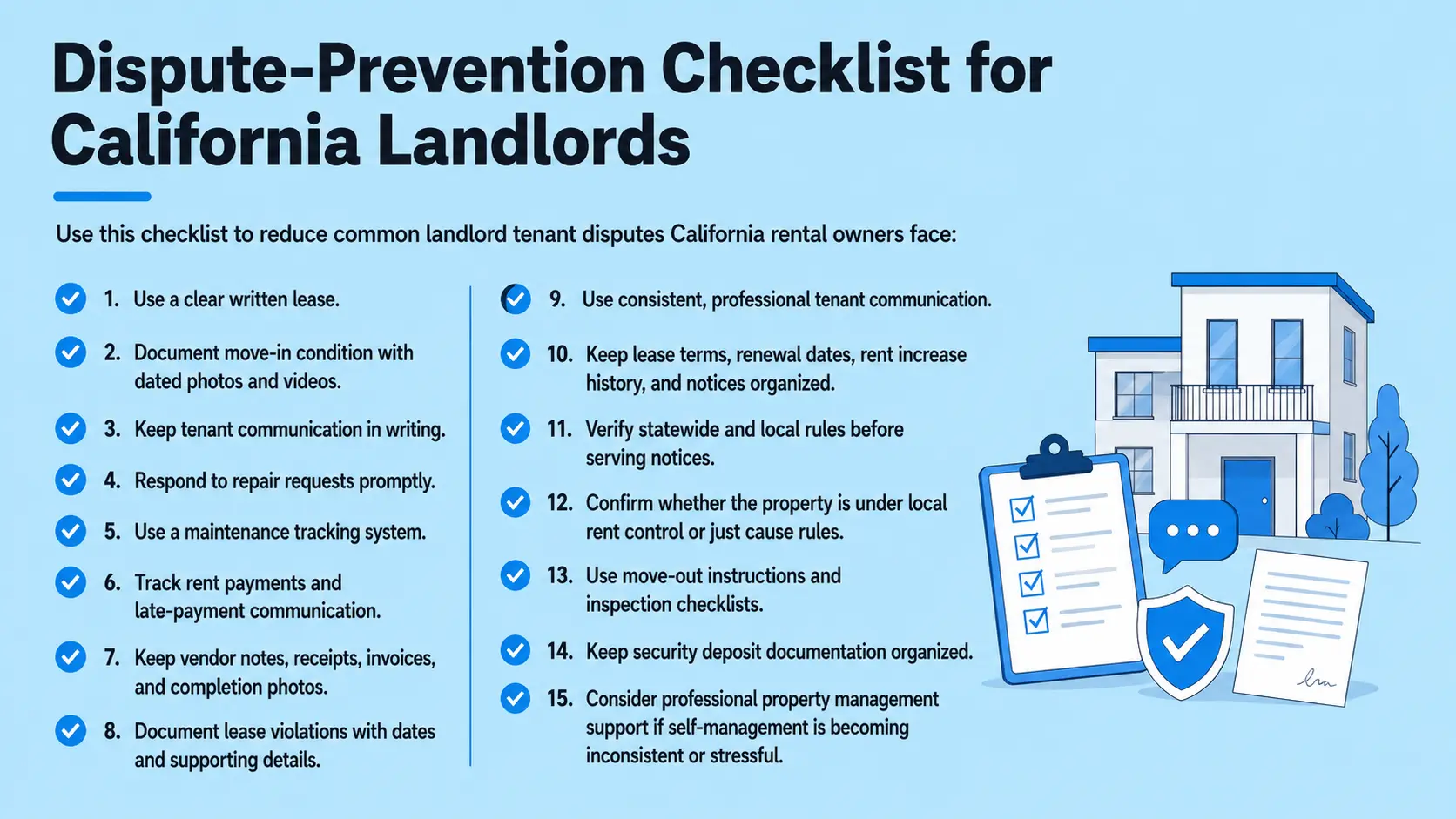
Open the image for a larger view, or download it to save for later.
DirectPads Expert Insight
From a property management perspective, many landlord-tenant disputes are really communication and documentation problems.
A repair request is not updated. A tenant moves in without detailed photos. A lease rule is mentioned verbally but never documented. A late rent pattern is handled inconsistently. A move-out charge is made without strong photo support. A vendor visit is scheduled, but the tenant says they were not properly informed.
None of these issues may seem major at first. But together, they create confusion.
For Southern California landlords, the practical takeaway is this: better systems reduce friction. They do not guarantee that disputes will never happen. They simply give owners a clearer record, a more consistent process, and a better way to manage tenant communication.
Self-managing landlords often underestimate how much time it takes to handle tenant messages, maintenance coordination, rent tracking, inspection workflows, vendor follow-up, lease tracking, and documentation. The stress rarely comes from one task. It comes from dozens of small tasks happening at once.
DirectPads’ property management perspective is that rental owners do not just need help “dealing with tenants.” They need a repeatable operating system for the property.
How DirectPads Helps Owners Reduce Tenant Dispute Stress
DirectPads helps Southern California rental owners manage the operational side of rental ownership with more clarity and consistency.
DirectPads can support owners with:
- Tenant communication
- Rent collection
- Maintenance coordination
- Move-in documentation
- Move-out coordination
- Inspection workflows
- Owner reporting
- Vendor coordination
- Lease tracking
- Documentation systems
- Day-to-day property management
DirectPads is not a law firm and does not provide legal advice. But a practical, transparent, technology-driven property management partner can help owners organize the workflows that often lead to confusion when handled informally.
For owners in Los Angeles County, strong systems are especially important. A landlord looking for Los Angeles property management may be dealing with local rules, tenant communication issues, maintenance coordination, inspections, and rent tracking all at the same time.
DirectPads also supports owners looking for Los Angeles property management, Pasadena property management, Glendale property management, Long Beach property management, Santa Monica property management, Burbank property management, Torrance property management, and West Hollywood property management support.
Owners who are still setting up their rental business may also benefit from understanding how to start a rental property business in Los Angeles before tenant issues become recurring problems.
For newer landlords across Southern California, avoiding common first-time landlord mistakes can help reduce problems caused by weak screening, poor documentation, delayed maintenance, and inconsistent communication.
Need Help Managing a Rental in Southern California?
If you own a rental property in Los Angeles County, Orange County, or Southern California and want help with tenant communication, maintenance coordination, inspections, documentation, rent collection, lease tracking, vendor coordination, and day-to-day rental management, DirectPads can help you manage your property with more clarity and less stress.
DirectPads is built for owners who want practical systems, transparent communication, technology-supported workflows, and organized property management without the guesswork of self-management.
Talk to DirectPads about Southern California property management support today.
FAQ: Common Landlord-Tenant Disputes in Southern California
What are the most common landlord-tenant disputes in California?
The most common disputes include repairs, maintenance delays, security deposit deductions, late rent, unpaid rent, property damage, normal wear and tear, unauthorized pets, unauthorized occupants, lease violations, access issues, rent increases, and move-out disagreements.
What repairs are California landlords responsible for?
California landlords generally must maintain rental housing in a habitable condition. Civil Code Section 1941.1 identifies conditions related to weather protection, plumbing, water, heat, electrical systems, sanitation, garbage receptacles, and safe floors, stairways, and railings. Owners should verify current requirements for their property and jurisdiction. (Source)
What are tenants responsible for in a California rental?
California Civil Code Section 1941.2 lists tenant responsibilities such as keeping occupied areas clean and sanitary, disposing of garbage properly, properly using electrical, gas, and plumbing fixtures, and not allowing willful damage by the tenant or people the tenant permits on the property. (Source)
Can a California landlord deduct from a security deposit for damage?
A landlord may be able to deduct for tenant-caused damage beyond ordinary wear and tear, but deposit deductions must follow California security deposit rules. Owners should document move-in condition, move-out condition, invoices, photos, and itemized deductions. (Source)
How can landlords avoid security deposit disputes?
Use move-in photos, move-out photos, written inspection notes, cleaning records, repair invoices, tenant acknowledgments, and clear move-out instructions. Deposit disputes are much easier to manage when the owner can show the before-and-after condition of the rental.
How much notice does a landlord need to enter a rental in California?
California Civil Code Section 1954 generally requires written notice stating the date, approximate time, and purpose of entry, unless an exception applies. Twenty-four hours is presumed reasonable notice absent evidence to the contrary. (Source)
Why do rent increase disputes happen in Los Angeles?
Rent increase disputes happen because owners and tenants may be unsure whether statewide rent caps, City of Los Angeles RSO, LA County RSTPO, AB 1482, just cause protections, or local city rules apply. Owners should verify the property’s location, coverage, exemption status, and current notice requirements before issuing an increase.
Can a property manager help reduce tenant disputes?
A property manager can help reduce confusion by organizing tenant communication, rent collection, maintenance coordination, inspection workflows, move-in documentation, move-out coordination, vendor coordination, lease tracking, and owner reporting. A property manager cannot guarantee that disputes will never happen, but better systems can make rental operations more consistent and less stressful.
Legal Disclaimer
This article is for general informational purposes only and is not legal advice. Landlord-tenant laws can change and may vary based on property type, lease terms, city, jurisdiction, rent-control status, tenancy length, and other facts. Property owners should verify current requirements with official sources or a qualified attorney before making legal decisions or serving notices.
[…] deposits are one of the most common sources of landlord-tenant disputes in California. For landlords, homeowners, ADU owners, rental property owners, and small investors, […]
[…] Build consistent photographic and digital documentation processes to support deductions and avoid disputes. […]
[…] are increasingly aware of their rights. Violations can lead to disputes, legal action, rent refunds, attorney’s fees, or other […]
[…] strong lease clearly outlines expectations for both parties. It reduces disputes and gives you a solid foundation if issues […]
[…] with tenants, handling disputes, and making constant decisions can be mentally […]
[…] Common Landlord-Tenant Disputes in SoCal […]