
Can Los Angeles Landlords Raise Rent in 2026?
Table of Contents
Many Los Angeles landlords can raise rent in 2026, but not every rental follows the same rule.
The amount you can increase rent depends on where the property is located, whether the unit is under rent control, whether AB 1482 applies, what the lease says, and whether you give the correct written notice.
That is where Los Angeles rental ownership gets confusing. A property in the City of Los Angeles may fall under the City’s Rent Stabilization Ordinance, often called LA RSO. A property in unincorporated Los Angeles County may fall under LA County’s Rent Stabilization and Tenant Protections Ordinance. A rental in Pasadena, Santa Monica, West Hollywood, Long Beach, Glendale, Burbank, Torrance, or another LA County city may follow different local rules.
So the better question is not only, “How much can I raise rent?”
The better question is, “Which rule applies to my property, and can I document the rent increase correctly?”
For owners who are self-managing, this is where organized property management matters. DirectPads helps Los Angeles County rental owners stay organized with rent collection, lease tracking, tenant communication, maintenance coordination, owner reporting, and documentation workflows. DirectPads is not a law firm and does not provide legal advice, but it helps owners manage the operational side of rental ownership with more clarity and less stress.
The Quick Answer: Yes, But Check the Rule First
Los Angeles landlords may be able to raise rent in 2026, but the allowable increase depends on the property.
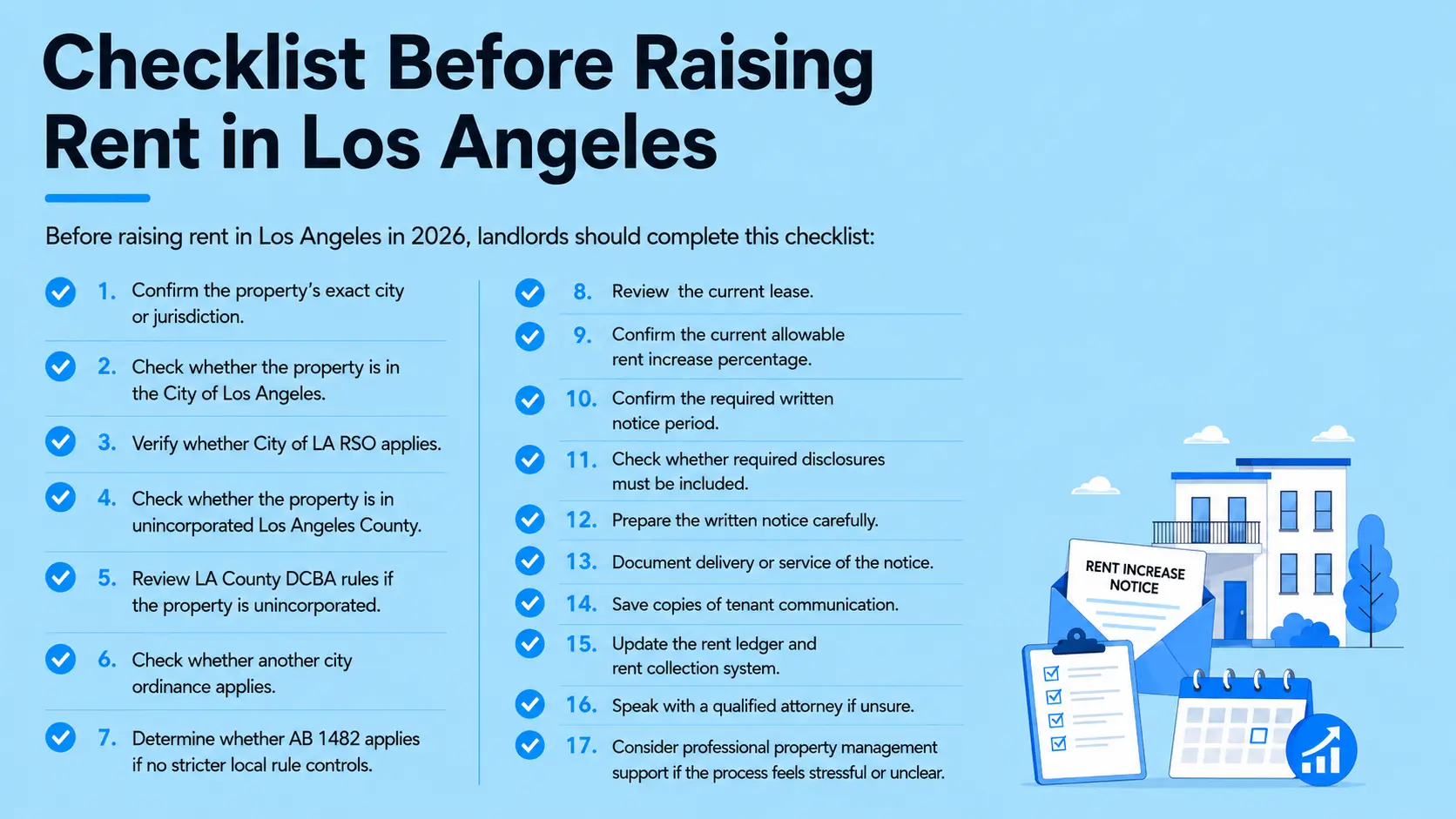
Before increasing rent, landlords should check:
- Is the property in the City of Los Angeles?
- Is the unit subject to LA RSO?
- Is the property in unincorporated Los Angeles County?
- Is the unit subject to LA County RSTPO?
- Is the unit covered by AB 1482 statewide rent caps?
- Is the unit in another LA County city with its own local rules?
- Does the lease allow the increase at this time?
- What written notice is required?
For City of Los Angeles RSO units, LAHD states that the annual allowable rent increase effective July 1, 2025 through June 30, 2026 is 3%. LAHD also states that beginning February 2, 2026, landlords can no longer include an additional percentage increase for utilities as part of the RSO annual rent increase. (Source)
LAHD’s renter-protection update also states that the RSO annual rent increase remains 3% from July 1, 2025 to June 30, 2027. Owners should still check LAHD before serving notices because rent rules can change. (Source)
First, Confirm the Property’s Jurisdiction
Before calculating a rent increase, confirm the property’s exact jurisdiction.
“Los Angeles” can mean several different things:
- City of Los Angeles
- Los Angeles County
- Unincorporated Los Angeles County
- Another city inside LA County, such as Pasadena, Glendale, Long Beach, Santa Monica, Burbank, Torrance, or West Hollywood
This matters because rent increase rules can change from one city to another. LA County DCBA explains that many incorporated cities have their own rent-control restrictions and that owners should contact the appropriate city to confirm which local rules apply. (Source)
For a broader landlord compliance overview, read DirectPads’ guide to Los Angeles rental laws in 2026. That article covers local Los Angeles rental law requirements beyond rent increases, including tenant notices, just cause rules, and landlord responsibilities.
Simple Comparison: Which Rent Rule Might Apply?
| Property Situation | Rule to Check First | What Owners Should Know |
|---|---|---|
| Rental unit in the City of Los Angeles, older or potentially rent-stabilized | City of Los Angeles RSO | LAHD may limit rent increases and regulate eviction reasons for covered units. |
| Rental in the City of Los Angeles but not RSO | City of LA Just Cause Ordinance and possibly AB 1482 | Non-RSO does not automatically mean “no rules.” Check local and state rules. |
| Rental in unincorporated Los Angeles County | LA County RSTPO | Fully covered units may have lower annual rent increase limits than AB 1482. |
| Rental not covered by stricter local rent control | AB 1482 statewide rent cap | Covered units are generally capped at 5% plus CPI, or 10%, whichever is lower. |
| Rental in Santa Monica, Pasadena, West Hollywood, Long Beach, or another LA County city | Local city rules first | Some cities have their own rent-control, rent-stabilization, or tenant-protection rules. |
City of Los Angeles Rent Stabilization Ordinance (RSO) Rent Increase Rules in 2026
The City of Los Angeles Rent Stabilization Ordinance, or LA RSO, applies to many rental units in the City of Los Angeles.
LAHD states that a rental unit may be subject to RSO if the property was built on or before October 1, 1978. Certain replacement units constructed after July 15, 2007 may also be covered. LAHD also states that RSO regulates rent increases and evictions. (Source)
What types of properties can be covered by LA RSO?
LAHD lists several property types that may be covered when the RSO requirements are met, including apartments, condominiums, townhomes, duplexes, two or more single-family dwelling units on the same parcel, rooms in hotels or motels occupied by the same tenant for 30 or more consecutive days, residential units attached to commercial buildings, ADUs, and JADUs. (Source)
This is important for ADU owners and small landlords. Do not assume an ADU, duplex, condo, or small property is automatically outside LA RSO. Check the property’s LAHD/ZIMAS status first.
How much can rent increase under LA RSO in 2026?
Can City of LA landlords still add utility percentages?
Beginning February 2, 2026, LAHD states that landlords can no longer include an additional percentage increase for utilities as part of the RSO annual rent increase. (Source)
This is a major update. Landlords should avoid using old rent increase templates that mention utility add-ons unless they have verified the current rule with LAHD.
How often can LA RSO rent be increased?
LAHD states that rent may be increased once every 12 months by the allowable rent increase percentage for covered RSO units. (Source)
What If the Property Is Not Under LA RSO?
If a rental property is not under City of Los Angeles RSO, the landlord should still check other rules.
Non-RSO does not automatically mean unlimited rent increases.
A non-RSO property may still be subject to:
- City of Los Angeles Just Cause Ordinance
- AB 1482 statewide rent caps
- Another local rent stabilization ordinance
- Lease restrictions
- Subsidy program rules
- Notice requirements under California law
California Civil Code Section 1947.12, commonly associated with AB 1482, limits covered rent increases to 5% plus the percentage change in cost of living, or 10%, whichever is lower, over a 12-month period. The law also limits rent increases for the same tenant to no more than two increments in a 12-month period, subject to the overall cap. (Source)
For statewide issues beyond this article, DirectPads’ guide to 2026 California property management laws for landlords is a useful supporting resource.
AB 1482 Rent Increase Rules for Los Angeles Owners
AB 1482 applies to many California rental properties, including some Los Angeles-area rentals that are not covered by stricter local rent control.
Under AB 1482, the general formula is:
5% + local CPI, or 10%, whichever is lower.
LA County DCBA states that as of August 2025, the maximum allowable annual rent increase in the Los Angeles area is 8.0% for AB 1482-covered units, based on 5% plus a local CPI of 3.0%. (Source)
For rent increases taking effect on or after August 1, 2026, California Civil Code Section 1947.12 uses the April CPI figure for that year. The State of California Department of Industrial Relations CPI table lists the April 2026 Los Angeles-Long Beach-Anaheim CPI-U all-items percentage change as 3.7%. Based on the AB 1482 formula, that points to an 8.7% cap for covered Los Angeles-area units, unless a stricter local rule applies. Owners should verify the current number before serving notice. (Source)
AB 1482 exemptions are not always simple
Some properties may be exempt from AB 1482, but owners should be careful.
Civil Code Section 1947.12 lists exemptions, including certain affordable housing, dormitories, housing subject to stricter local rent control, housing issued a certificate of occupancy within the previous 15 years, certain separately alienable residential property such as some single-family homes or condos if statutory conditions are met, and certain owner-occupied two-unit properties. (Source)
The risky mistake is saying, “It is a single-family home, so AB 1482 does not apply.”
That may be true in some cases, but the exemption can depend on ownership structure, required notice language, and other facts. Owners should confirm before relying on an exemption.
LA County Rent Stabilization Rules for Unincorporated Areas
| Effective Period | General Fully Covered Units | Qualifying Small Property Landlords | Luxury Units |
|---|---|---|---|
| July 1, 2025 – June 30, 2026 | 1.930% | 2.930% | 3.930% |
| July 1, 2026 – June 30, 2027 | 1.919% | 2.919% | 3.919% |
| LA County RSTPO Rent Increase Bulletin (source) | |||
DCBA also states that qualifying small property landlords must submit annual self-certification and include required disclosure language in the rent increase notice. Landlords of luxury units must also include required disclosure language. (Source)
That means LA County landlords should not only check the percentage. They should also check whether the unit is fully covered, whether the property is registered, whether the required notices are included, and whether at least 12 months have passed since the last allowable increase.
What About Other LA County Cities?
Other cities inside Los Angeles County may have their own rules.
For example:
Santa Monica
2.6%Santa Monica’s Rent Control Board announced a September 2026 General Adjustment of 2.6% for eligible units, with a maximum increase for certain units. (source)
Long Beach
AB 1482Long Beach points landlords to AB 1482 statewide rent caps and local tenant-landlord resources. (source)
Pasadena
2.25%Pasadena states that the Annual General Adjustment is 2.25% from October 1, 2025 through September 30, 2026 for covered units, subject to listed exceptions and notice requirements. (source)
West Hollywood
2.25%West Hollywood lists a 2.25% Annual General Adjustment for rent increases effective September 1, 2025 to August 31, 2026 and states rent increases can only be applied once every 12 months. (source)
These examples show why landlords should not rely on one “Los Angeles rent increase 2026” number for every property. A Los Angeles property management plan should start with the exact address and the correct local agency.
California Rent Increase Notice Requirements
Landlords generally need to give written notice before increasing rent.
California Civil Code Section 827 states that for covered residential periodic tenancies, a rent increase of 10% or less requires at least 30 days’ written notice. If the proposed rent increase is greater than 10%, either by itself or combined with other rent increases in the previous 12 months, the landlord generally must provide at least 90 days’ written notice. (Source)
That said, notice rules can vary. A lease, local ordinance, subsidy program, or other regulation may require more time or specific language. When in doubt, owners should verify with the applicable housing department or a qualified attorney before serving a notice.
Common Rent Increase Mistakes Los Angeles Landlords Make
Los Angeles rent increase mistakes usually happen when owners skip steps.
Common mistakes include:
- Assuming every Los Angeles property follows the same rule
- Confusing City of Los Angeles with Los Angeles County
- Forgetting to check whether the unit is under LA RSO
- Using outdated LAHD percentages or old utility add-on language
- Assuming AB 1482 applies when a stricter local rule controls
- Assuming AB 1482 does not apply without checking the exemption rules
- Giving the wrong notice period
- Raising rent during a fixed-term lease when the lease does not allow it
- Raising rent too often within a 12-month period
- Forgetting required LA County RSTPO disclosures
- Not keeping proof of service or tenant communication
- Failing to save copies of leases, rent ledgers, and notices
For self-managing landlords, these mistakes can happen easily because the rules are spread across multiple agencies. A good property management system keeps the documents, dates, and communication organized.
Open the image for a larger view, or download it to save for later.
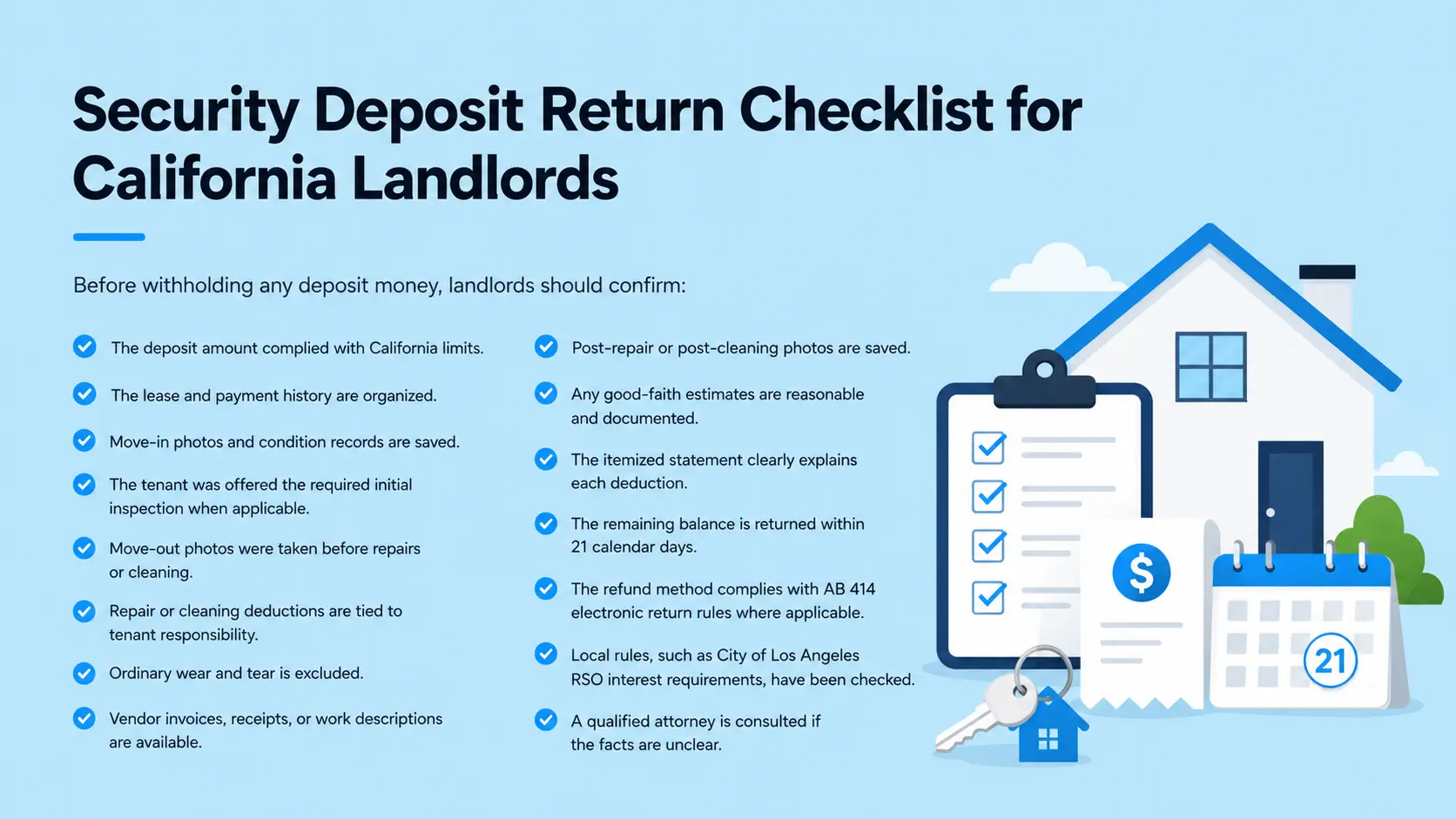
Open the image for a larger view, or download it to save for later.
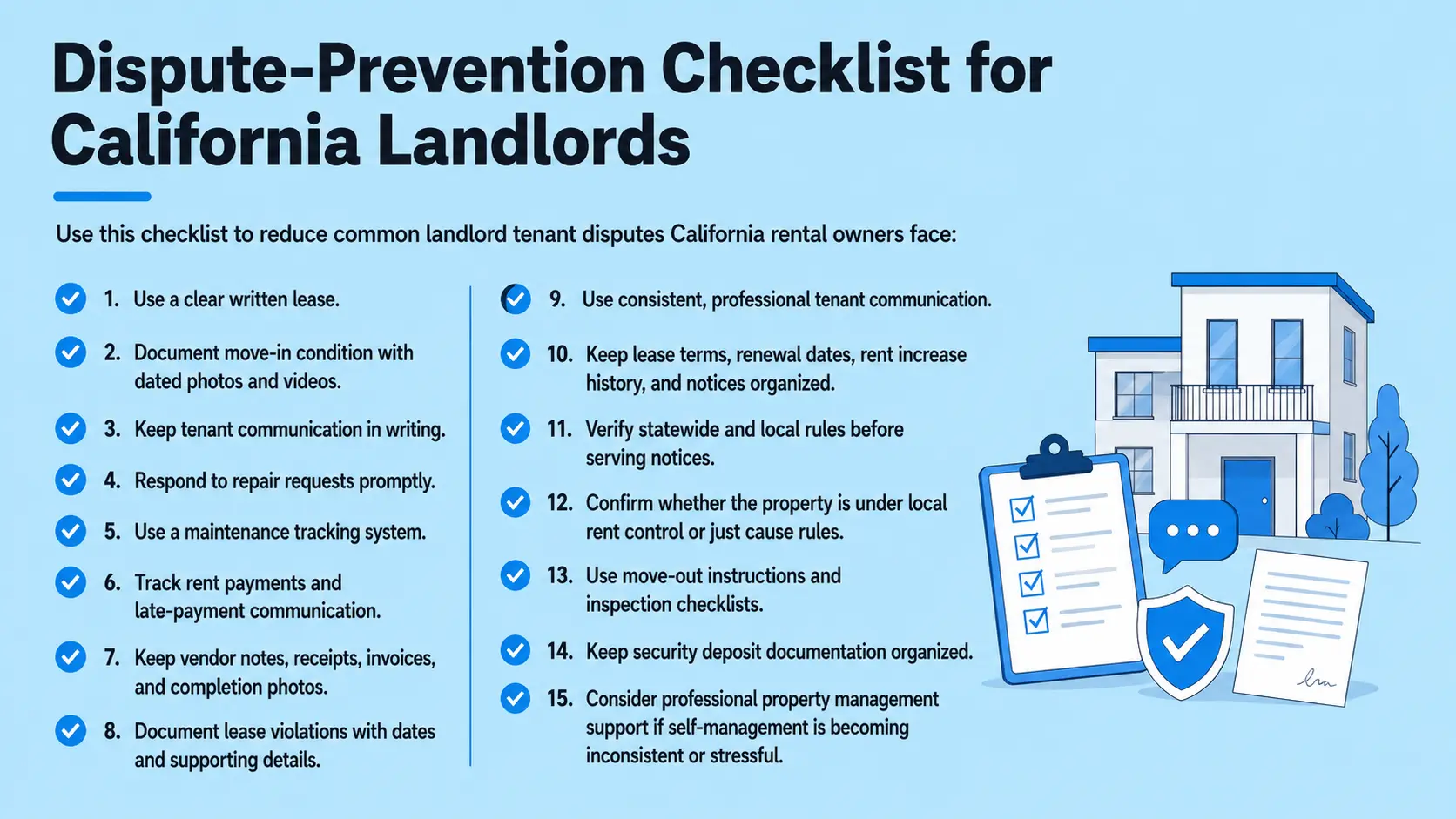
Open the image for a larger view, or download it to save for later.
Documents Landlords Should Keep
After a rent increase, landlords should keep organized records of:
- Current lease or rental agreement
- Prior rent amount
- New rent amount
- Rent increase calculation
- Rent increase notice
- Proof of service or delivery
- Tenant communication
- Rent ledger
- Applicable agency guidance used
- Property registration records if required
- Any required disclosures
These records matter because rent increases are not just accounting changes. They are property management events that should be documented clearly.
DirectPads Expert Insight
Many landlords focus on the question, “How much can I raise rent?”
DirectPads’ property management perspective is that landlords should ask a better question:
“Can I raise rent correctly, document it properly, communicate it clearly, and keep the property profitable without creating avoidable tenant disputes?”
That question is more useful for Los Angeles rental owners.
A landlord may know the right percentage but still make a mistake with jurisdiction, lease timing, notice language, tenant communication, or recordkeeping. In Los Angeles County, where City of LA RSO, LA County RSTPO, AB 1482, and local city rules can overlap, self-management can become stressful fast.
DirectPads does not provide legal advice. But from an operational property management standpoint, rent increases should be handled through a clear workflow: check the rule, review the lease, calculate the increase, prepare the notice, document delivery, update the ledger, and keep communication organized.
That kind of system helps owners manage with more confidence.
How DirectPads Helps Los Angeles Landlords Stay Organized
DirectPads helps rental owners manage the operational side of rental ownership.
For Los Angeles County landlords, homeowners, ADU owners, small investors, and self-managing owners, DirectPads can help with:
- Rent collection
- Lease tracking
- Tenant communication
- Maintenance coordination
- Owner reporting
- Documentation workflows
- Property management systems
- Day-to-day rental management support
DirectPads is not a law firm and does not replace legal counsel. Instead, DirectPads helps owners stay organized around the property management tasks that often create confusion when they are handled manually.
If you own rental property in Los Angeles County, organized systems can help you track rent changes, lease dates, tenant notices, maintenance issues, and owner records in one more manageable process.
Need Help Managing a Rental in Los Angeles County?
If you own a rental property in Los Angeles County and are unsure about rent increases, tenant notices, lease tracking, maintenance, or day-to-day management, DirectPads can help you manage your rental with more clarity and less stress.
DirectPads supports owners with practical, transparent, technology-driven property management across Los Angeles County.
FAQ: Los Angeles Rent Increase Rules in 2026
Can Los Angeles landlords raise rent in 2026?
Yes, many Los Angeles landlords can raise rent in 2026, but the allowable amount depends on the property’s jurisdiction, rent-control status, lease terms, and notice requirements. City of LA RSO, LA County RSTPO, AB 1482, or another local ordinance may apply.
How much can a landlord raise rent in Los Angeles in 2026?
It depends. For City of Los Angeles RSO units, LAHD states the annual allowable rent increase is 3% for July 1, 2025 through June 30, 2026, and LAHD’s renter-protection update states the RSO annual increase remains 3% from July 1, 2025 to June 30, 2027. Other properties may follow AB 1482, LA County RSTPO, or another local rule. (Source)
What is LA RSO?
LA RSO is the City of Los Angeles Rent Stabilization Ordinance. LAHD states that RSO regulates rent increases and evictions for covered rental units. Many covered properties were built on or before October 1, 1978, but owners should verify coverage using LAHD resources. (Source)
Does AB 1482 apply in Los Angeles?
AB 1482 may apply to some Los Angeles rental properties if they are not covered by stricter local rent control and are not exempt. Civil Code Section 1947.12 generally limits covered rent increases to 5% plus CPI, or 10%, whichever is lower. (Source)
What is the difference between City of LA RSO and LA County RSTPO?
City of LA RSO applies to covered units in the City of Los Angeles. LA County RSTPO applies to eligible properties in unincorporated Los Angeles County. The agencies, formulas, coverage rules, and allowable rent increases are different, so owners should verify the property’s exact jurisdiction before raising rent.
Do Los Angeles landlords need to give written notice before raising rent?
Yes. California Civil Code Section 827 generally requires at least 30 days’ written notice for rent increases of 10% or less and at least 90 days’ written notice for increases greater than 10%, measured alone or combined with other increases in the prior 12 months. Local rules, leases, or subsidy programs may require additional steps. (Source)
Does LA rent control apply to single-family homes, condos, or ADUs?
It depends. A single-family home that is the only residential structure on a parcel is generally not subject to City of LA RSO, according to LAHD, but other rules may still apply. ADUs and JADUs can be covered by LA RSO when the coverage criteria are met. AB 1482 exemptions for some separately alienable homes or condos also depend on ownership structure and required notice language. Owners should verify before relying on an exemption. (Source)
What should landlords check before increasing rent in Los Angeles?
Landlords should check the property’s city, RSO status, LA County status, AB 1482 applicability, local city rules, lease terms, current allowable increase, written notice requirements, required disclosures, and documentation process. When unsure, owners should contact the correct housing department or a qualified attorney before issuing a notice.
Legal Disclaimer
This article is for general informational purposes only and is not legal advice. Rental laws and rent increase limits change frequently and may vary by city, jurisdiction, property type, rent-control status, lease terms, tenancy, ownership structure, exemption status, and effective date. Property owners should verify current rules with LAHD, LA County DCBA, the applicable city or county agency, or a qualified attorney before issuing rent increases or legal notices.