
AI-Powered Property Management in Anaheim, CA
Helping Anaheim rental property owners streamline tenant screening, rent collection, and maintenance with AI-powered property management built to improve efficiency and returns.

AI-Powered Property Management in Anaheim, CA
Helping Anaheim rental property owners streamline tenant screening, rent collection, and maintenance with AI-powered property management built to improve efficiency and returns.

Overview
About Anaheim
Anaheim is one of the most dynamic cities in Orange County, known for its tourism-driven economy and diverse residential communities. Beyond its global reputation as an entertainment destination, Anaheim supports a strong local workforce in hospitality, healthcare, manufacturing, and logistics. Its central location, access to major freeways, and proximity to job hubs across Southern California make it a practical choice for commuters and long-term residents alike. With ongoing development and infrastructure investment, Anaheim continues to evolve as both a lifestyle destination and a stable environment for rental property growth.
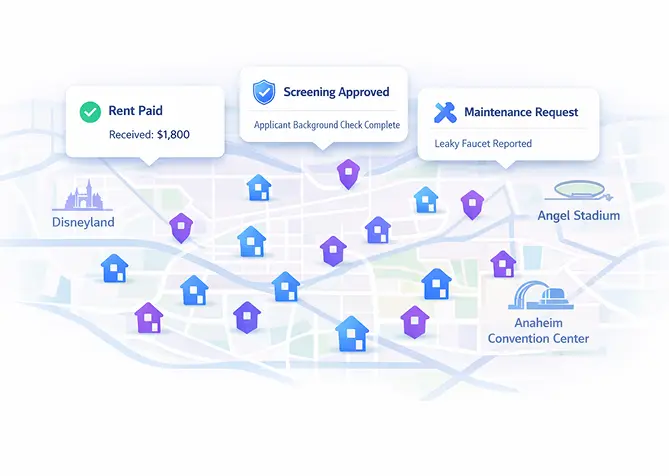
Anaheim's rental market moves fast
Tourism, entertainment, and a growing local workforce drive consistent demand across Anaheim's diverse rental properties, Anaheim’s rental market is more affordable than some neighboring cities like Irvine, while still offering strong demand and consistent occupancy.
Market Stats
Average Rent in Anaheim, CA
Rental prices vary depending on neighborhood, property type, and proximity to major attractions. Typical rental ranges include:
2026 Rent Snapshot
Average Rent in Anaheim
Anaheim rents remain elevated compared with national averages, though pricing varies by source, property type, and nearby rental alternatives.
Apartment Average Rent
$2,470
↑ 0.44% Year over year
1-Bedroom Apartments
$2,229
Monthly average
2-Bedroom Units
$2,740
Monthly average
3-Bedroom Homes
$3,245
Monthly average
Rent by Unit Type
A quick visual comparison of monthly rent levels.
↗ Rental Trend Insight
Anaheim is slightly more affordable than luxury coastal Orange County cities, but it remains a strong rental market where accurate pricing matters because renters have multiple nearby alternatives.
Data shown: RentCafe average rent market trends. Source
Numbers
Vacancy Rates in Anaheim, CA
Anaheim generally maintains steady occupancy levels due to its strong employment base and tourism-driven economy.
- Orange County Multifamily Vacancy Proxy: CBRE reported that Orange County’s multifamily market closed Q1 2026 with a 96.1% occupancy rate, which implies an approximate 3.9% vacancy rate. (Source)
- Matthews Real Estate Investment Services also reported Orange County multifamily vacancy at approximately 4.3% in Q1 2026, describing it as one of the lowest vacancy levels among major U.S. markets. (Source)

Why This Matters: A vacancy rate near 4% suggests a tight rental market, meaning well-priced Anaheim rental properties can remain competitive, but landlords still need strong pricing, marketing, and retention strategies.
Rules
Anaheim Landlord-Tenant Laws Overview
Anaheim landlords operate within California's strict regulatory framework. Understanding rent control limits, deposit caps, and notice requirements keeps you compliant and protects your investment.
AB 1482 – California Rent Control
Annual increases are capped at 5% plus local CPI or 10% maximum, whichever is lower. Just cause is required for certain evictions after the first year.

Security deposits have strict limits
Unfurnished units are limited to one month's rent, furnished units to two months. Deposits must be returned within 21 days after move-out with itemized deductions.
Notice periods protect both parties
Three days for unpaid rent, 30 days for month-to-month tenants under one year, 60 days for longer tenancies. Proper documentation prevents costly legal disputes.

Lead-based paint disclosure requirements
Properties built before 1978 must disclose lead-based paint hazards to all prospective tenants. Failure to provide proper disclosure violates federal law and exposes you to significant liability and fines.

Short-term rental rules in Anaheim
Anaheim enforces strict short-term rental regulations for units rented under 30 days. Property owners must register units, comply with occupancy limits, and collect local taxes or face substantial fines.

California tenant rights and protections
Tenants have legal rights to habitable conditions, privacy, and anti-discrimination protection. Landlords cannot retaliate when enforcing lease terms. Understanding these rights prevents costly disputes and legal complications.

Everything You Need
In One Place.
DirectPads brings tenant screening, rent collection, and maintenance coordination together in a single dashboard. No more switching between apps or chasing down information.
AI Maintenance Coordination
Tenants submit repair requests 24/7 with photos. Issues are routed, tracked, and documented from request to resolution.
Rent Collection & Fast Owner Payouts
Tenants pay online, reminders run automatically, and owner payouts are sent within 24–48 hours after collection.
Real-Time Owner Portal
See rent status, expenses, invoices, photos, maintenance updates, and monthly statements without waiting on email updates.
Tenant Communication
DirectPads helps manage tenant requests, payment reminders, maintenance updates, and everyday communication with a clear response process.
Vendor Bids With Zero Markup
We coordinate vendor bids and repair work without padding invoices. You see the real cost, not a marked-up version.
Monthly Statements & Reporting
Track income, expenses, maintenance costs, invoices, and owner statements in one clean, transparent reporting system.
Move-In / Move-Out Documentation
Photos, maintenance history, rent records, invoices, and unit-level documents are organized so important details do not disappear.
Ralph AI Portfolio Assistant
Ask plain-English questions about unpaid tenants, open repairs, lease renewals, reports, and property activity across your portfolio.
Modern management for owners who want fewer surprises.
Flat monthly pricing. Transparent repairs. Real-time visibility. A simpler way to manage rentals across Southern California.
Local Legal Considerations in Anaheim, CA
For landlords and property managers in Anaheim, CA, compliance is shaped by California statewide landlord-tenant law, city short-term rental rules, fair housing requirements, and ongoing local discussions around rent protections.
Statewide Rent Cap & Tenant Protection Laws
Anaheim’s city rent-increase guidance points landlords to California’s statewide AB 1482 framework. The City of Anaheim states that landlords cannot raise rent annually by more than 5% plus inflation based on the local Consumer Price Index, or 10%, whichever is lower, under California Civil Code Section 1947.12. Anaheim also notes that exempt units may require at least 90 days’ notice if rent will be increased by more than 10%. California’s Attorney General explains that residential tenants may be protected from certain rent increases and certain types of evictions under state law. Because Anaheim does not operate like Santa Ana, which has its own local rent stabilization system, property managers should confirm whether each Anaheim rental is covered by AB 1482 or exempt.
Short-Term Rental Permit Rules
Anaheim has detailed short-term rental regulations, which are especially important because of the city’s tourism market. Anaheim defines short-term rental activity as residential rental use from 3 days to less than 30 days, and property owners must obtain a short-term rental permit to operate legally. Anaheim’s official short-term rental FAQ states that owners or agents must rent short-term rental properties for a minimum of 3 nights. Anaheim Municipal Code conditions include occupancy limits, parking requirements, written rental agreements, and guest responsibility rules for short-term rental operations. For landlords, this means Anaheim short-term rental income is not a simple Airbnb-style strategy. It requires permit compliance, operational controls, and ongoing monitoring.
Security Deposit Handling and Move-Out Documentation
California security deposit rules apply to Anaheim rental properties. California Courts states that after a tenant moves out, a landlord has 21 days to return the full security deposit or return the remaining amount with an itemized statement explaining deductions. If deductions exceed $125, the landlord must attach invoices, receipts, or a written explanation of work performed. Allowable deductions generally include cleaning the unit back to its original move-in condition, repairing tenant-caused damage beyond normal wear and tear, and restoring or replacing personal property when allowed by the rental agreement. For Anaheim property managers, detailed move-in photos, inspection notes, repair invoices, and move-out communication are essential to reduce disputes.
Habitability and 2026 Appliance Requirements
California’s 2026 habitability updates affect Anaheim landlords and property managers. AB 628 requires most California residential rental units to include a working stove and refrigerator beginning January 1, 2026, for qualifying leases entered into, amended, renewed, or extended on or after that date. The California Apartment Association also reported that AB 628 requires rental units to have a working stove and refrigerator. This matters for Anaheim landlords because appliance maintenance should now be treated as a core compliance issue, not just an amenity decision.
Fair Housing and Anti-Discrimination Compliance
Anaheim landlords must also follow federal and California fair housing rules. The City of Anaheim states that it promotes fair and equal housing opportunities and enforces fair housing protections under Title VIII of the Civil Rights Act of 1968 and the California Fair Employment and Housing Act. The Fair Housing Council of Orange County provides counseling on housing rights, landlord obligations, tenant obligations, and landlord-tenant problems in Orange County. For property managers, this means advertising, screening, lease enforcement, reasonable accommodation requests, and tenant communication should be handled consistently and documented carefully.
Smarter property management, with owners still in control.
DirectPads uses AI to organize tenant requests, maintenance details, rent status, payments, reporting, and owner communication — all at a flat monthly rate with no percentage of rent, no setup fee, and no hidden surprises.
AI-powered. Owner-approved. Fully transparent.
Requests come in clearly
Tenants can submit maintenance needs with photos, notes, and details so issues are easier to understand from the start.
AI organizes the workflow
DirectPads helps route issues, collect vendor bids, track job progress, send reminders, and keep everything moving.
Owners see what matters
Your real-time owner portal surfaces rent collection, payments, reporting, maintenance status, and payout updates.
Ralph answers in plain English
Ralph, the AI assistant inside the owner portal, helps answer owner questions without digging through emails or reports.
Local Legal Considerations for Landlord/Tenant in Huntington Beach, CA
For landlords and property managers in Huntington Beach, staying compliant with both California state law and local ordinances is key. Here's a summary of legal requirements to ensure smooth operations in 2026.
Statewide Rent Cap & Tenant Protection Laws
Under the California Tenant Protection Act, commonly referred to as AB 1482, rent increases for covered units are generally limited to 5% of the current rent plus CPI, or 10% total, whichever is lower, annually. After 12 months of tenancy, landlords must generally provide just cause for eviction, such as non-payment, lease violations, or property damage. Some properties may be exempt, including newer construction, owner-occupied properties, and some single-family homes. These rules are designed to prevent arbitrary rent hikes while maintaining reasonable protections for landlords and tenants.
Local Just Cause & Tenant Protections
While Huntington Beach does not have a citywide rent control ordinance, landlords and property managers should still pay close attention to tenant protection requirements and just cause eviction standards. Tenants generally cannot be removed without a lawful reason, such as nonpayment of rent, lease violations, or other legally recognized causes. Property managers should document notices, lease issues, payment history, and communication carefully to reduce risk and avoid costly disputes.
Habitability Standards & Maintenance Obligations
California habitability standards apply statewide, including in Huntington Beach. Landlords must provide safe and livable rental housing, including working plumbing, heating, electrical systems, structural integrity, and other essential conditions. Maintenance requests should be addressed within a reasonable time, and property managers should keep clear records of repairs, inspections, and tenant communications. Regular inspections and fast response times can help prevent disputes and protect tenant satisfaction.
State Law Compliance & 2026 Updates
California rental housing laws continue to evolve, so property managers should review lease agreements, security deposit procedures, maintenance policies, and required disclosures for 2026 compliance. Updates may affect appliances, documentation, security deposit handling, electronic refunds, and landlord communication practices. Property managers should verify current requirements before making policy changes or issuing notices.
Local Legal Considerations for Landlord/Tenant in Santa Ana, CA
When managing rental properties in Santa Ana, CA, it’s crucial for landlords to understand the local legal framework that governs landlord-tenant relationships. These legal considerations go beyond state laws and include local ordinances that protect tenants’ rights and provide guidance on rent control, evictions, and registration. Below are some of the most important legal aspects landlords and property managers must be aware of:
Local Rent Stabilization & Just Cause Eviction Ordinance
Santa Ana is one of the few Orange County cities with its own rent stabilization and just cause eviction ordinance, which affects how and when landlords may adjust rents and end tenancies. For covered units, rent increases may be limited to the lower of 3% or 80% of the Consumer Price Index annually, operating alongside California’s statewide rent limits under AB 1482. Just cause eviction protections also apply, meaning a landlord must cite a valid reason, such as nonpayment or a lease violation, before terminating a tenancy. These local protections help tenants but also mean landlords must carefully calculate allowable rent increases and maintain compliance documentation.
Mandatory Rental Registry
Under the Rent Stabilization Ordinance, all rental units in Santa Ana must be registered with the city or documented as exempt. Registration helps the city track units covered by rent stabilization, verify allowable rent increases, and enforce compliance. Landlords must keep unit and tenancy information updated through the city’s online rental registry portal. Failing to register can lead to fines or other enforcement actions, making this a crucial administrative task for property managers.
Statewide Law Compliance — California AB 1482
Beyond local rules, Santa Ana landlords also must comply with California’s Tenant Protection Act, commonly known as AB 1482. For many properties, particularly older multifamily structures, AB 1482 limits annual rent increases to 5% plus CPI, with a maximum of 10%, and requires statewide just cause eviction protections after at least 12 months of tenancy. Property managers should verify which statute applies for each property because local and state rules may overlap and affect allowable rent adjustments, notices, and eviction proceedings.
Ongoing Legal Developments (2026)
Santa Ana continues to refine its housing regulations. Recent city council action has targeted the use of automated rent-setting algorithms in leasing to prevent pricing practices that could negatively impact affordability. Legal challenges concerning the ordinance and its enforcement structures remain active in local courts, though the core protections remain enforceable as of 2026. Landlords should stay tuned to updates from the Rent Stabilization Division and local council meetings, as changes can directly impact lease renewals, rent setting, and eviction procedures.
Local Legal Considerations for Landlord/Tenant in Costa Mesa, CA
Property managers in Costa Mesa, CA must navigate both state-level landlord-tenant laws and local regulations. Here’s an overview of the legal framework affecting rental management in the city.
Local Just Cause & Tenant Protections Ordinance
While Costa Mesa does not have local rent control, the Tenant Protection Ordinance includes just cause eviction requirements. Landlords are generally required to have a valid reason for terminating a tenancy, such as nonpayment, property damage, lease violations, or another legally recognized basis. Costa Mesa also has specific exemptions that may apply to certain housing types, including some newer buildings. These protections help ensure that landlords can evict only for valid, justifiable reasons while protecting tenants from arbitrary eviction.
2026 California Landlord-Tenant Law Updates
Several statewide legal updates may affect landlords and property managers in and around 2026. Updated disclosure and transparency requirements may require clearer communication around mandatory charges, including management, parking, amenity, or other recurring fees. Statewide habitability guidance may also affect appliance requirements, including basic appliances such as refrigerators and stoves when applicable. Property managers should review leases, advertising, disclosures, and internal procedures to verify current compliance before making policy changes.
Fair Housing and Anti-Discrimination Compliance
In Costa Mesa, as in all of California, landlords must comply with fair housing laws that prohibit discrimination based on protected characteristics, including race, religion, national origin, gender, familial status, disability, and source of income, including government benefits. Failure to comply with these standards can result in lawsuits, damages, or fines. Landlords and property managers should document communications, leasing decisions, screening standards, accommodation requests, and other rental-related actions to help reduce risk.
Local Legal Considerations for Landlord/Tenant in Newport Beach, CA
Managing rental property in Newport Beach requires more than market knowledge. Landlords and property managers must follow California landlord-tenant laws and local requirements that affect lease terms, disclosures, deposits, tenant screening, maintenance, and compliance throughout the tenancy.
California Security Deposit Law
California security deposit rules apply to rental properties in Newport Beach. Landlords must generally return security deposits within 21 calendar days after a tenant moves out. If deductions are made for repairs or cleaning, landlords should provide an itemized statement and supporting receipts when required. Failure to follow deposit timelines and documentation requirements can increase the risk of disputes, penalties, or loss of the right to retain part of the deposit. Clear records, move-in documentation, and move-out inspection notes can help reduce legal risk.
Fair Housing and Anti-Discrimination Compliance
Landlords and property managers in Newport Beach must comply with federal and California fair housing laws. These rules prohibit discrimination in rental advertising, tenant screening, leasing, renewals, and property management practices based on protected characteristics such as race, gender, disability, familial status, sexual orientation, and source of income. Property managers should also document reasonable accommodation requests and apply screening standards consistently. Failure to follow fair housing requirements can lead to legal liability, fines, and damages.
Local Newport Beach Considerations
Newport Beach does not have a local rent control ordinance, but landlords should still follow California statewide tenant protection laws and local legal procedures. Tenancy disputes, habitability concerns, notices, repairs, and lease terminations often follow broader California and Orange County legal processes. Property managers should document tenant communications, maintenance requests, notices, and dispute resolution steps carefully. Landlords should verify current local requirements before taking action or issuing notices.
2026 California Landlord-Tenant Law Updates
Several statewide legal updates may affect landlords and property managers in and around 2026. Updated disclosure and transparency requirements may require clearer communication around mandatory charges, including management, parking, amenity, or other recurring fees. Statewide habitability guidance may also affect appliance requirements, including basic appliances such as refrigerators and stoves when applicable. Property managers should review leases, advertising, disclosures, and internal procedures to verify current compliance before making policy changes.
Automation
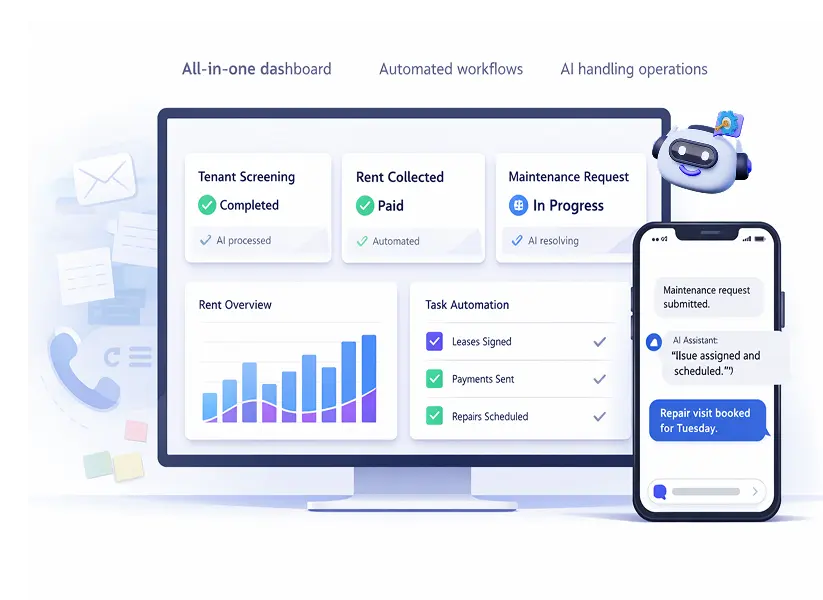
AI Automation that saves you hours every week
DirectPads handles tenant screening, rent collection, and maintenance coordination automatically so you don't have to. The platform evaluates applicants through AI, processes payments without your involvement, and connects tenants with service providers, all while you focus on growing your portfolio instead of drowning in paperwork.
Simplicity
Why Anaheim Landlords Choose DirectPads
Automation reduces the time managers spend on routine tasks by approximately 50 percent, freeing them to focus on more strategic and creative work that requires human judgment and decision-making.
Automation
Qualified tenants arrive faster
AI evaluates credit, income, and rental history without paperwork. Qualified candidates surface in hours while risky applications get filtered automatically.

Speed
Fill vacancies before competitors do
Anaheim's tight rental market rewards landlords who move fast. Optimized listings and rapid screening mean fewer vacant days and more income in your pocket.
Efficiency
Manage more with less effort
Automated rent collection, maintenance tracking, and lease management eliminate routine work. One dashboard replaces scattered emails, spreadsheets, and phone calls.


Independence
Built for landlords who manage alone
Whether you own one property or a dozen, DirectPads scales with your portfolio. Remote landlords get the same control and visibility as those managing properties in person.
Location We Serve
Property management across Southern California
DirectPads serves landlords across Orange County's most active rental markets
Ready to simplify your rentals?
See how DirectPads automates property management for Orange County landlords
FAQ
Questions about Orange County property management
DirectPads charges a flat monthly rate instead of a percentage of rent. The Essential plan is $199/month, and the All-Inclusive plan is $299/month, regardless of rent amount. There are no setup fees, no percentage-based management fees, and no hidden charges.
Leasing time depends on market conditions, pricing, property condition, and demand. DirectPads lists rentals on major platforms, conducts showings, manages applications, and typically places qualified tenants within 2–4 weeks of listing.
According to RentCafe, the average apartment rent in Anaheim was $2,470 per month, last updated April 22, 2026, reflecting a 0.44% year-over-year increase. Actual rent still depends on property type, size, location, condition, and amenities, so landlords should compare similar rentals in Anaheim before setting a price.
DirectPads screens applicants through credit checks, income verification, rental history, background checks, and eviction history. Qualified applicants are presented for review, while the final approval decision remains with the property owner.
Yes. DirectPads handles rent collection, and owner payouts are processed within 24–48 hours after tenant payment clears. Funds are deposited directly into the owner’s bank account automatically.
Anaheim landlords must follow applicable California and local rental housing rules, including requirements related to rent increases, notices, security deposits, leases, and tenant protections. Property owners should make sure their rental practices follow the laws that apply to their specific property.
Rental performance in Anaheim depends on location, pricing, property condition, and demand. DirectPads manages single-family homes, 2–4 unit properties, 5+ unit buildings, and commercial properties.
Yes. DirectPads includes AI maintenance coordination, a tenant portal, vendor management, and an owner portal where vendor bids are visible. DirectPads does not mark up vendor invoices, so what the contractor charges is exactly what the owner pays.
Anaheim is part of the Orange County rental market and can be attractive to investors depending on the property, location, pricing, and long-term rental demand. DirectPads helps owners manage rental operations with flat-rate property management, tenant support, maintenance coordination, and reporting.
DirectPads offers flat-rate property management with an owner portal, tenant portal, AI-powered maintenance routing, automated accounting, tenant communication support, and no percentage-based management fee. Owners stay informed through the portal without having to handle day-to-day tenant management directly.
Cities We Serve in Orange County
DirectPads supports landlords and rental property owners throughout Orange County, including:
Ready for stress-free property management?
Let DirectPads handle everything — from tenants to repairs — while you focus on what matters most.
The Basics of Virtual Selling
To get started selling your home, join our app and upload your basic property information. We’ll also ask for photos and videos of your homes for sale. After that, an agent will interview you about your home and its features. We may also have your home independently reviewed by the appropriate professionals for the job.
We use the information obtained during this session to create a cash offer for your home at market price, as well as create a home listing to share in a California multiple listing service. New listings like yours can attract attention from established companies like Seven Gables Real Estate or Harcourts Prime Properties.
Our virtual marketplace provides transaction coordination services that meet the quality of agents with real estate licenses. Our service allows you to avoid real estate agents and their fees.
How to List Your Home for Sale?
Our listing broker can create an enticing, accurate listing for your property. Our property listings are discounted, so you can maximize your profit as much as possible.
Multiple listing data enables buyers to find the right property. We cooperate with brokers deemed reliable and share property listings. Sharing data about Orange County homes helps us match buyers to home for sale in San Juan Capistrano, Newport Beach, and beyond.
Essential components of any listing include square footage, lot size, school attendance zone boundaries, and more. We’ll also note if properties reside in popular zip codes.
Buyers can search for disability accommodation requests, such as ramps or one-story houses, or for other features. Such information is essential during the decision-making process. We have more filters than many other sources for real estate listings.
We are continuously working to help our clients find buyers. Our California regional multiple listing service will show your home to as many interested buyers as possible.
Selling Your Home
At DirectPads, we work with various real estate professional companies, including home staging companies, contractors, and a professional photographer to showcase your home at its best.
An open house gives buyers the opportunity to identify prospective properties they find interesting. A personal inspection can help them make their choice and independently verify the listed data prior to buying the home.
We can sell both commercial and non-commercial real estate. We serve both north and south Orange County. Our technology is unrivaled, and we seek to provide a positive web experience for all our clients.
Save money as you sell homes anywhere from Laguna Hills to Dana Point, contact us at DirectPads today!